

HubSpot Portal Health Insights Without the Enterprise Price Tag
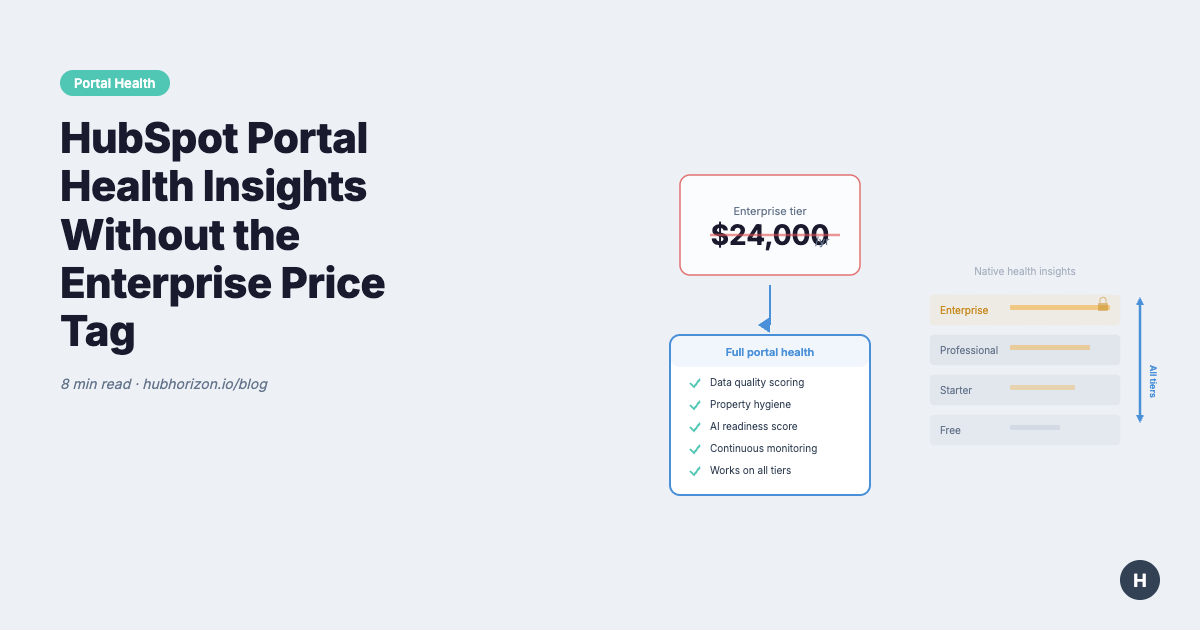
HubSpot gates portal health insights behind Enterprise ($24K/year). Get deeper diagnostics and AI readiness scoring for a fraction of the cost.

Peter Sterkenburg
HubSpot Solutions Architect & Revenue Operations expert. 20+ years B2B SaaS experience. Founder of HubHorizon.
HubSpot's Data Hub (formerly Operations Hub) includes useful data quality features — duplicate detection, automated formatting fixes, property anomaly monitoring. But here's the catch: the deeper portal health insights live behind the Enterprise tier.
That's $2,000 per month. $24,000 per year.
For many HubSpot teams — especially those on Starter or Professional plans — that price tag puts portal health intelligence out of reach. You're left with basic data hygiene tools or manual spreadsheet audits that take weeks.
Here's what HubSpot's native tiers include for data quality, where the gaps are, and how to get full portal health analysis without upgrading to Enterprise.
What HubSpot includes at each tier
HubSpot's data quality capabilities are spread across pricing tiers, and the feature gating is significant:
Free / Starter (up to $20/month)
- Basic property settings and management
- Manual duplicate detection for Contacts and Companies
- Standard reports and dashboards
- No automated data quality tools
- No property health insights
At this level, you're managing data quality entirely by hand. There's no automated detection of issues, no health scoring, and no proactive monitoring. If you want to understand what a health score actually measures, see our CRM health score guide.
Professional ($800/month)
- Data Quality Command Center dashboard
- AI-powered duplicate detection and merging
- Automated formatting fixes (phone numbers, names, capitalisation)
- Basic property anomaly monitoring
- Data sync across systems
- Programmable automation (Operations Hub feature)
Professional is where data quality tooling begins. The Data Quality Command Center surfaces formatting issues, identifies duplicates, and flags properties with anomalies. It's a meaningful step up from the Starter tier.
But it's operational, not diagnostic. It tells you "these records have formatting issues" and "these contacts are duplicates." It doesn't cover the six data quality dimensions that actually determine your portal's health:
- What your overall portal health score is
- Whether your data is ready for AI applications
- Which properties have the worst naming conventions
- How your association completeness compares to best practices
- What your RevOps methodology alignment looks like
- Whether you have sensitive data stored in inappropriate fields
Enterprise ($2,000/month)
- Everything in Professional
- Advanced data governance controls
- Custom data quality rules and thresholds
- Extended property health insights
- Advanced user permissions for data management
- Conversation intelligence
- Predictive lead scoring
Enterprise unlocks deeper property health insights and governance controls. But it bundles these with a massive feature set that most teams don't need — conversation intelligence, advanced permissions, predictive scoring, and more.
If you're upgrading to Enterprise primarily for better data quality visibility, you're paying $24,000/year for a feature that represents a fraction of the tier's value.
The real cost of "free" native tools
When evaluating HubSpot's native data quality features, consider the total cost:
If you're on Professional ($800/month = $9,600/year): You get basic data hygiene but no overall health scoring, no AI readiness assessment, and no property-level diagnostics beyond anomaly flags.
If you want to upgrade to Enterprise ($2,000/month = $24,000/year): That's an additional $14,400/year over Professional — just for deeper data quality insights plus features you may not need.
If you're on Starter ($20/month = $240/year): You have no automated data quality tools at all. The jump to Professional for data quality alone is $9,360/year.
The "included in your subscription" positioning obscures the reality: HubSpot's advanced data quality features carry a significant implicit cost. For a detailed breakdown of how dedicated tools compare on features and pricing, see our HubSpot audit tools comparison.
What's missing from every HubSpot tier
Even on Enterprise, HubSpot's native tools have fundamental limitations for portal health analysis:
No composite health score
HubSpot doesn't provide a single "your portal health is 73/100" score. It shows individual issues (duplicates, formatting problems, anomalies) but doesn't aggregate them into an actionable score you can track over time and present to leadership.
Without a composite score, you can't answer the basic question: "Is our CRM getting healthier or sicker?"
No AI readiness assessment
With AI becoming central to sales and marketing workflows (predictive scoring, content recommendations, automated segmentation), you need to know whether your data can reliably power these tools.
HubSpot doesn't evaluate your data's AI readiness. There's no assessment of whether your property structure, data completeness, consistency, and association integrity are sufficient for machine learning applications.
No methodology alignment scoring
RevOps teams implementing sales methodologies (MEDDIC, MEDDICC, SPICED, BANT) need to know whether their CRM is configured to support them. Which fields are missing? Which objects lack the properties required for methodology compliance?
HubSpot's native tools don't evaluate your portal against sales methodology frameworks.
No cross-object association analysis
How complete are the links between your Contacts, Companies, Deals, and Tickets? What percentage of Deals have associated Contacts? How many Contacts are orphaned without Company associations?
HubSpot provides basic association management but doesn't score your association completeness or identify systemic gaps across object relationships.
No sensitive data detection
Is there PII stored in free-text fields where it shouldn't be? Are there credit card numbers, social security numbers, or health data in your CRM that create compliance risk?
HubSpot doesn't scan your property values for sensitive data patterns. If you're not sure what a thorough audit covers, our data quality audit guide walks through all 10 areas.
No property-level health scoring
Beyond flagging unused properties, HubSpot doesn't evaluate individual properties on naming convention compliance, description quality, fill rate trends, data type appropriateness, or dependency mapping.
No independent audit perspective
There's an inherent limitation in HubSpot grading its own homework. An independent tool can identify configuration anti-patterns, missing best practices, and optimisation opportunities that the platform provider has no incentive to surface.
The alternative: Dedicated portal health tools
Dedicated HubSpot portal health platforms fill these gaps for much less.
HubHorizon, for example, provides full portal health analysis starting at EUR 199/year (roughly $215/year) — compared to $24,000/year for Enterprise.
Here's what a dedicated portal health tool provides that HubSpot's native tools don't:
Composite health scoring
A single 0-100 health score that aggregates property health, data quality, association completeness, and configuration effectiveness across all objects. Track it monthly. Present it to leadership. Set improvement targets.
AI readiness framework
A structured assessment of whether your CRM data can reliably power AI applications — scored across completeness, consistency, associations, activity depth, governance maturity, and compliance posture.
Methodology alignment
Automated scoring against sales frameworks like MEDDIC, MEDDICC, SPICED, BANT, and ICP Alignment. See exactly which properties are present, which are missing, and what to add.
Deep property analysis
Per-property health scoring including naming convention compliance, fill rates, usage tracking, duplicate detection, dependency mapping, and data type validation.
Association completeness
Cross-object relationship analysis identifying orphaned records, missing associations, and systemic gaps in your data relationships.
Sensitive data detection
Automated scanning for PII patterns, compliance risk indicators, and data that shouldn't be in your CRM.
Prioritised recommendations
Not just a list of issues, but a prioritised action plan weighted by business impact — what to fix first for maximum improvement.
Continuous monitoring
Monthly refreshes that track your health score over time, showing whether your portal is improving or degrading.
Cost comparison
Let's put the numbers side by side:
| Capability | HubSpot Professional | HubSpot Enterprise | Dedicated Tool (e.g., HubHorizon) |
|---|---|---|---|
| Annual cost | $9,600/year | $24,000/year | EUR 199-399/year |
| Composite health score | No | Limited | Yes (0-100) |
| AI readiness scoring | No | No | Yes (6 pillars) |
| Methodology alignment | No | No | Yes (5 frameworks) |
| Property-level analysis | Basic anomalies | Extended insights | Deep (naming, fill rates, usage) |
| Association analysis | No | No | Yes |
| Sensitive data detection | No | No | Yes |
| Duplicate detection | Yes | Yes | Yes |
| Formatting fixes | Yes | Yes | Recommendations |
| Continuous monitoring | Dashboard | Dashboard | Monthly refresh + trends |
| Exportable reports | Limited | Limited | PDF/CSV |
| Independent audit | No (self-assessment) | No (self-assessment) | Yes |
The dedicated tool doesn't replace HubSpot's operational features (duplicate merging, formatting fixes). It adds a diagnostic and strategic layer that HubSpot doesn't provide at any tier.
When you do need Enterprise
To be fair, HubSpot Enterprise is valuable for teams that genuinely need its full feature set:
- Custom objects with advanced configuration
- Conversation intelligence for sales coaching
- Predictive lead scoring using HubSpot's AI
- Advanced permissions for large teams with complex access needs
- Sandboxes for testing configuration changes
- Revenue attribution reporting
If you need three or more of these capabilities, Enterprise may be the right investment. The data governance improvements are a bonus on top of the features you're actually buying.
But if your primary motivation for considering Enterprise is "I need better visibility into my portal health" — stop. A dedicated tool gives you deeper insights for 1% of the cost.
The practical approach
Here's what a cost-effective portal health strategy looks like:
Step 1: Keep your current HubSpot tier. Whether you're on Starter, Professional, or Enterprise, your tier should be driven by the hub features you need — not data quality tooling.
Step 2: Add a dedicated portal health tool. Connect it to your portal for continuous health scoring, AI readiness assessment, and property-level diagnostics. Cost: EUR 199-399/year.
Step 3: Use HubSpot's native tools for operational fixes. Duplicate merging, formatting corrections, and basic property management work well with what HubSpot provides natively.
Step 4: Pair with a data operations tool if needed. If you have significant data cleanup work (thousands of duplicates, major formatting issues), add a tool like Insycle for hands-on remediation.
Total cost for full portal health visibility: EUR 199-399/year plus your existing HubSpot subscription.
Compare that to upgrading to Enterprise for the same visibility: $14,400-$23,760 more per year.
Don't upgrade for data quality visibility
HubSpot's tier pricing makes sense for hub features — marketing automation, sales sequences, service tickets, custom objects. These are capabilities deeply embedded in the platform that can't be replicated externally.
But data quality visibility is a diagnostic function. An external tool connecting via API can analyze your portal with the same (or better) depth than native tools, at a fraction of the cost.
The worst investment is paying $24,000/year for Enterprise when your primary motivation is understanding your portal health. The best investment is a dedicated tool that gives you deeper insights for less than the cost of a single manual audit.
Your HubSpot budget should go toward features that require the platform. Everything else — diagnostics, analysis, health scoring — can be handled more effectively and affordably by purpose-built tools.
Frequently Asked Questions
Can you monitor HubSpot portal health without Enterprise?
Yes — you can get comprehensive portal health visibility without upgrading to HubSpot Enterprise. Native HubSpot tools at Professional tier provide basic usage data, but they don't produce a composite health score, surface AI readiness gaps, or align your data quality against sales methodology frameworks. Purpose-built tools connect via the HubSpot API and deliver deeper diagnostic insight than native tooling at any tier, for a fraction of the cost.
What HubSpot data quality features require Enterprise?
HubSpot Enterprise adds custom reporting, advanced data management settings, and admin permissions, but it does not include a composite portal health score, fill-rate analysis across your full property set, or AI readiness evaluation. These diagnostic capabilities — which tell you whether your CRM data is actually reliable — are not natively available at any HubSpot tier. They require a dedicated analysis tool built specifically for that purpose.
How much does HubSpot portal health monitoring cost?
Dedicated portal health tools typically cost around 1% of the annual Enterprise licence fee. A full HubSpot Enterprise suite can exceed $24,000 per year; purpose-built health monitoring tools start at a few hundred dollars annually. If your primary motivation for considering Enterprise is diagnostic visibility, a dedicated tool delivers more targeted insight at a dramatically lower price point. Compare HubHorizon plans to see what fits your team.
What is a HubSpot portal health score?
A HubSpot portal health score is a composite metric that aggregates data quality, property hygiene, record completeness, workflow reliability, and AI readiness into a single numeric assessment. Unlike individual HubSpot reports, a health score gives you one number that reflects the overall state of your CRM — and tracks whether it's improving or deteriorating over time. HubHorizon's free health check explains how the score is calculated and what it measures.
See your portal health for free
HubHorizon provides a free health score preview for any HubSpot portal. Connect in 30 seconds, see your scores in under 5 minutes. No credit card, no Enterprise upgrade required.
Get your free portal health analysis at hubhorizon.io — compare plans and pricing to find the right fit for your team.
Find out what your portal health looks like today — and whether your current HubSpot tier already gives you everything you need.
Peter Sterkenburg is the founder of HubHorizon, a HubSpot portal health and optimisation platform. He's spent years in scale-up RevOps — building the systems, fighting the fires, and eventually building the tool he wished he'd had.
Related articles
The HubSpot Pipeline Management Cheat Sheet: Views, Signals, and Reviews in One Place
One-page HubSpot pipeline reference: 6 deal health signals, warning thresholds, 9 saved view recipes, stage design checklist, and review prep guide.
Read articleYour HubSpot Pipeline Is a Data Structure. Most Are Broken.
Your deal pipeline is a data structure. When stages, exit criteria, and required properties break, forecasting and AI produce garbage. Diagnose and fix it.
Read articleWhy Your HubSpot Sales Forecast Is Wrong — and It's Not a Process Problem
Most forecasting failures are data failures, not process failures. Diagnose and fix the data foundation your HubSpot forecast depends on.
Read article