

The 6 Data Quality Dimensions Every HubSpot Admin Should Measure
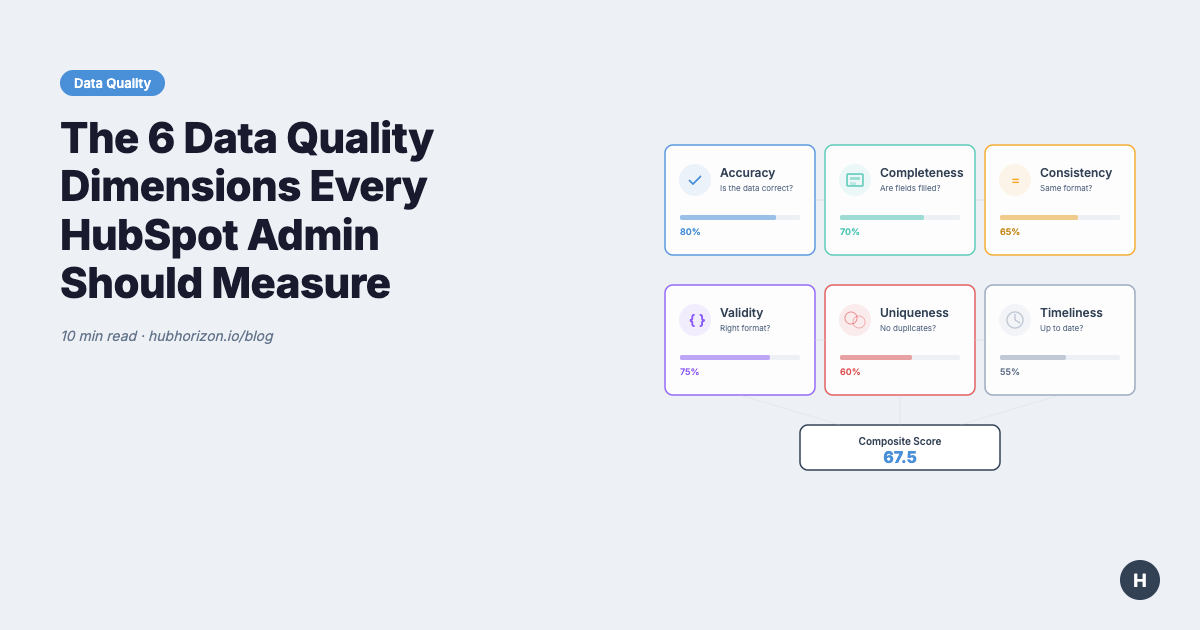
The 6 data quality dimensions — accuracy, completeness, consistency, validity, uniqueness, timeliness — and how to measure each in HubSpot.

Peter Sterkenburg
HubSpot Solutions Architect & Revenue Operations expert. 20+ years B2B SaaS experience. Founder of HubHorizon.
"Our data quality needs work." Every RevOps team has said it. But what does "data quality" actually mean? It's vague enough to mean anything — and when something means everything, it's hard to measure, prioritize, or fix.
Data management professionals solved this problem decades ago by breaking data quality into measurable dimensions. Six core dimensions, to be specific. Each one covers a different aspect of quality. You can define, measure, and improve them independently.
They map to the diagnostic categories in a CRM health audit. When you understand them, you stop saying "our data is bad" and start saying "our completeness is 72%, our validity is failing on phone number formatting, and our uniqueness score dropped 4 points after last month's import."
That's actionable. Here are the six dimensions and how to measure each one in HubSpot.
The 6 core data quality dimensions
Data quality dimensions are the six measurable attributes that define whether CRM data is fit for purpose: accuracy, completeness, consistency, validity, uniqueness, and timeliness. Together they provide a structured framework for auditing, scoring, and improving data quality in any CRM — including HubSpot.
1. Accuracy — Does your data reflect reality?
Accuracy measures whether the values stored in your CRM match the real-world facts they represent. A contact's job title should reflect their actual role. A deal amount should match the proposal or contract. A company's industry classification should match what the company actually does.
In HubSpot, accuracy breaks down when:
- Job titles are outdated (the contact got promoted two years ago)
- Deal amounts are estimates that were never updated after negotiation
- Company sizes reflect the information available at import, not the current headcount
- Email addresses belong to people who have left the organisation
- Lead sources are guessed rather than tracked
Accuracy is the hardest dimension to measure automatically because it requires comparison against an external source of truth. You can catch some accuracy issues through cross-field validation — if a contact's lifecycle stage is "Customer" but they have no closed-won deals, something is inaccurate. But most accuracy problems require periodic manual review or enrichment from external data providers.
How to measure it: Cross-field validation checks, enrichment data comparison, bounce rates on emails (indicating stale addresses), and periodic manual spot-checks on high-value records. For a deeper look at how accuracy factors into a composite score, see our guide on CRM health scores.
2. Completeness — Are all required fields present?
Completeness is about whether the fields that should contain data actually contain data. It's the most straightforward dimension to measure: for any given property, what percentage of records have a value?
In HubSpot, completeness problems look like:
- Contacts without job titles, phone numbers, or lifecycle stages
- Companies without industry, employee count, or revenue range
- Deals without close dates, amounts, or associated Contacts
- Tickets without priority, category, or resolution notes
Not every field needs to be populated on every record. Completeness scoring should focus on fields that are critical for your business processes — the properties that drive automation, segmentation, reporting, and AI tools.
How to measure it: Calculate fill rates for your critical properties. Start with the 10-15 properties your team uses most. A fill rate below 80% on a business-critical field is a problem worth fixing. Our AI readiness checklist uses completeness as its first pillar because machine learning models can't work with empty fields. The data quality audit guide covers fill rate analysis in detail.
3. Consistency — Does the same data match across records?
Consistency measures whether the same information is represented the same way everywhere it appears. When a contact's company name says "Acme Inc." but the associated company record says "ACME Corporation," that's a consistency failure. When lifecycle stage says "Customer" but deal stage says "Proposal Sent," your data contradicts itself.
Consistency operates at two levels:
Within HubSpot: Do related fields align? Does the contact's company match the deal's company? Do lifecycle stages reflect deal progression? Are picklist values used the same way across records?
Across systems: Does the customer record in HubSpot match billing data in Stripe, support history in Intercom, and product usage in your analytics platform? Cross-system consistency is harder to maintain but equally important for teams relying on integrated data.
How to measure it: Run cross-field validation rules (lifecycle stage vs deal status, contact company vs deal company). Check picklist value distribution — if "industry" has 200 unique values representing 15 actual industries, consistency is low. Our CRM health score guide weights consistency at 15-20% of the composite score. The Breeze AI readiness checklist covers why Breeze specifically needs consistent categorical values to segment and personalise effectively.
4. Validity — Does data conform to defined rules?
Validity checks whether data follows the format, type, and range rules you've defined. An email address should match email format. A phone number should follow E.164. A date should be a date, not a text string. A revenue field should contain a number, not "approximately $500K."
Validity is related to accuracy but not the same thing. A phone number can be valid (correct format, correct country code) but inaccurate (it's the wrong person's number). And a value can be accurate (it's the right person's number) but invalid (missing the country code). Both matter.
In HubSpot, validity problems include:
- Phone numbers in inconsistent formats (123-456-7890 vs +11234567890 vs (123) 456-7890)
- Numbers stored as text (prevents calculations and sorting)
- Free-text fields containing values that should be dropdowns (50 variations of "Technology" as an industry)
- Date information stored as text strings
- Boolean values represented as "Yes"/"No" text instead of true/false
How to measure it: Check data type mismatches (are numerical fields actually storing numbers?). Analyse format consistency within specific fields (do all phone numbers follow the same pattern?). Review free-text fields for values that should be controlled vocabularies. The data quality audit guide covers data type mismatches and required field strategy. Our property hygiene guide explains how schema design affects validity.
5. Uniqueness — Are there duplicates?
Uniqueness measures whether each real-world entity is represented exactly once in your CRM. Duplicate Contacts, Companies, and Deals fragment your data and distort every metric built on top of it.
The cost of poor uniqueness in HubSpot:
- Sales reps unknowingly contact the same person from different records, creating a disjointed experience
- Activity history is split across duplicates — no single record shows the full engagement picture
- Reporting overcounts Contacts, Companies, or pipeline value
- Automation fires multiple times for the same person
- AI models train on duplicated data, learning inflated patterns
Duplicates typically enter through imports, integrations, manual creation by team members who don't search first, and form submissions with slightly different email addresses or company names.
How to measure it: Run HubSpot's native duplicate detection. Check for near-duplicates (same company, different domain spelling; same person, personal vs work email). Calculate your duplicate rate as a percentage of total records. The data quality audit guide covers duplicate detection strategies in detail. A duplicate rate above 3% signals a process problem that needs attention.
6. Timeliness — Is data available and current?
Timeliness is about whether your data is current enough to support the decisions being made with it. A contact record last updated three years ago may have an outdated job title, a disconnected phone number, and a company that's been acquired.
Timeliness is distinct from accuracy, though they overlap: data that was accurate when entered becomes inaccurate over time. The timeliness dimension asks specifically about recency — how fresh is the data?
In HubSpot, timeliness problems look like:
- Large numbers of contacts with no activity in 12+ months
- Deal close dates that have passed without resolution (stuck deals)
- Company records with firmographic data that was enriched years ago
- Properties that haven't been updated since the original import
- Contact records from events, campaigns, or partnerships that are no longer active
How to measure it: Track the percentage of records updated within the last 90 days. Monitor average time since last activity per contact. Identify "data ghosts" — records with zero engagement that are aging in your database. Our CRM health score guide calls this the "data freshness" component and weights it at 10-15% of the composite score.
The governance layer: Where dimensions meet discipline
The six dimensions tell you what to measure. But who decides the acceptable thresholds? Who enforces the rules? Who is accountable when quality degrades?
That's the governance layer — and it sits above the dimensions in a clear hierarchy.
Data governance — Setting the rules
Data governance defines the policies, standards, and ownership structures that determine how data should be managed. It answers: who can create properties? What naming conventions apply? What are the minimum fill rate requirements? How often should data be audited?
Without governance, the six dimensions degrade naturally. Team members enter data inconsistently. New properties are created without standards. Imports introduce formatting variations. Quality erodes by default.
Governance is the topic the RevOps maturity model tracks most closely across its five levels — from ad hoc (no governance) to optimised (autonomous quality monitoring). The property hygiene guide covers property-level governance practices in depth.
Data integrity — Enforcing the rules
Data integrity sits between governance policies and the measured dimensions. It's the constraints, validation rules, workflows, and automation that keep bad data from entering your CRM — or catch it when it does.
In HubSpot, integrity enforcement includes:
- Required fields on forms (prevents incomplete records)
- Property validation rules (restricts format and range)
- Dropdown fields instead of free text (prevents inconsistency)
- Workflows that flag or auto-correct violations (e.g., standardise phone format on entry)
- Duplicate detection rules that prevent creation of matching records
- Lifecycle stage automation that enforces progression logic
How they connect
Think of it as a three-layer hierarchy:
Governance (top) sets the rules — policies, standards, ownership, audit schedules.
Integrity (middle) enforces the rules — validation, constraints, workflows, automation.
Dimensions (bottom) are the measurable outcomes — accuracy, completeness, consistency, validity, uniqueness, timeliness.
Overall data quality is the composite result of all six dimensions. If your governance is weak, integrity is unenforced, and dimensions are unmeasured, quality degrades silently until something breaks. A workflow fires on bad data. A report produces wrong numbers. An AI tool returns confidently wrong predictions.
The teams that maintain high data quality measure the dimensions, enforce integrity where data enters, and have governance policies that people actually follow.
Dimensions as CRM diagnostic categories
Each data quality dimension maps directly to a diagnostic category in a HubSpot portal audit. This is what makes the framework practical:
| Dimension | What to Measure in HubSpot | Tools / Methods | Benchmark |
|---|---|---|---|
| Accuracy | Cross-field contradictions, stale values, enrichment match rates | Validation workflows, enrichment comparison, bounce rates | <5% cross-field conflicts |
| Completeness | Fill rates on critical properties per object | Property reports, HubHorizon analysis | >85% on business-critical fields |
| Consistency | Value standardisation, cross-object alignment, picklist hygiene | Cross-field validation, value distribution analysis | <5% cross-object contradictions |
| Validity | Format compliance, data type correctness, range adherence | Format checks, type audits, schema review | >95% format compliance |
| Uniqueness | Duplicate Contact, Company, and Deal rates | HubSpot dedup tools, Insycle, HubHorizon | <3% duplicate rate |
| Timeliness | Records updated in last 90 days, inactive contact %, data age | Activity recency analysis, staleness reports | >60% updated quarterly |
When you run a data quality audit — whether manually or using automated tools — you're measuring these six dimensions. The vocabulary gives you precision. Instead of "data is messy," you can identify exactly which dimension is failing and focus your remediation effort there.
Measuring your dimensions
Self-assessment (30 minutes)
Rate each dimension 1-5 based on your current knowledge of your portal:
- 1 (Critical): No measurement, known severe problems
- 3 (Needs work): Some awareness, inconsistent enforcement
- 5 (Healthy): Regularly measured, actively maintained, clear standards
If your total score is below 18/30, start with the lowest-scoring dimension. Fixing one dimension often improves others — better governance (rules) improves validity (format compliance), which improves consistency (standardised values), which improves uniqueness (fewer near-duplicates from formatting variations).
Automated assessment (5 minutes)
HubHorizon scores each dimension automatically by connecting to your HubSpot portal. The analysis evaluates fill rates, format compliance, association completeness, duplicate rates, data freshness, and governance indicators — then aggregates them into a composite health score.
Automated measurement is objective and frequent. Manual assessments happen quarterly at best. Automated scoring can track monthly trends and catch degradation early — before it impacts reporting, automation, or AI tools.
Frequently Asked Questions
What are the 6 data quality dimensions?
The six data quality dimensions are accuracy (does data reflect reality?), completeness (are fields populated?), consistency (does data match across records?), validity (does it follow defined formats?), uniqueness (are there duplicates?), and timeliness (is it current?). These are formally defined in data management frameworks like DAMA-DMBOK and apply to any CRM, including HubSpot.
How do you measure data quality in HubSpot?
Each dimension maps to measurable indicators in HubSpot: field fill rates (completeness), duplicate counts (uniqueness), format compliance (validity), cross-field agreement (consistency), last-modified timestamps (timeliness), and comparison against external sources (accuracy). Automated tools like HubHorizon score all six dimensions by connecting to your portal and analysing property data directly.
Which data quality dimension matters most?
It depends on your use case. For AI and machine learning, completeness and consistency matter most — models need populated, standardised fields. For sales operations, accuracy and timeliness are critical — reps need current, correct information. For compliance (GDPR, CCPA), uniqueness and validity take priority. Start by fixing whichever dimension scores lowest in your portal.
How often should you audit data quality?
Quarterly is the minimum for a meaningful data quality programme. Monthly automated scoring catches degradation earlier. You should also trigger an audit after bulk imports, integration changes, team restructures, or any event that introduces large volumes of new or modified data.
Start measuring
Data quality is six numbers. When you know your scores across these dimensions, you know where to invest effort. If you're not measuring them, you're guessing.
Get your data quality dimension scores at hubhorizon.io — connect your portal in 30 seconds, see per-dimension scores in under 5 minutes. No credit card required. View pricing plans for continuous dimension tracking, trend monitoring, and exportable audit reports.
Peter Sterkenburg is the founder of HubHorizon, a HubSpot portal health and optimisation platform. He's spent years in scale-up RevOps — building the systems, fighting the fires, and eventually building the tool he wished he'd had.
Related articles
The HubSpot Pipeline Management Cheat Sheet: Views, Signals, and Reviews in One Place
One-page HubSpot pipeline reference: 6 deal health signals, warning thresholds, 9 saved view recipes, stage design checklist, and review prep guide.
Read articleYour HubSpot Pipeline Is a Data Structure. Most Are Broken.
Your deal pipeline is a data structure. When stages, exit criteria, and required properties break, forecasting and AI produce garbage. Diagnose and fix it.
Read articleWhy Your HubSpot Sales Forecast Is Wrong — and It's Not a Process Problem
Most forecasting failures are data failures, not process failures. Diagnose and fix the data foundation your HubSpot forecast depends on.
Read article