

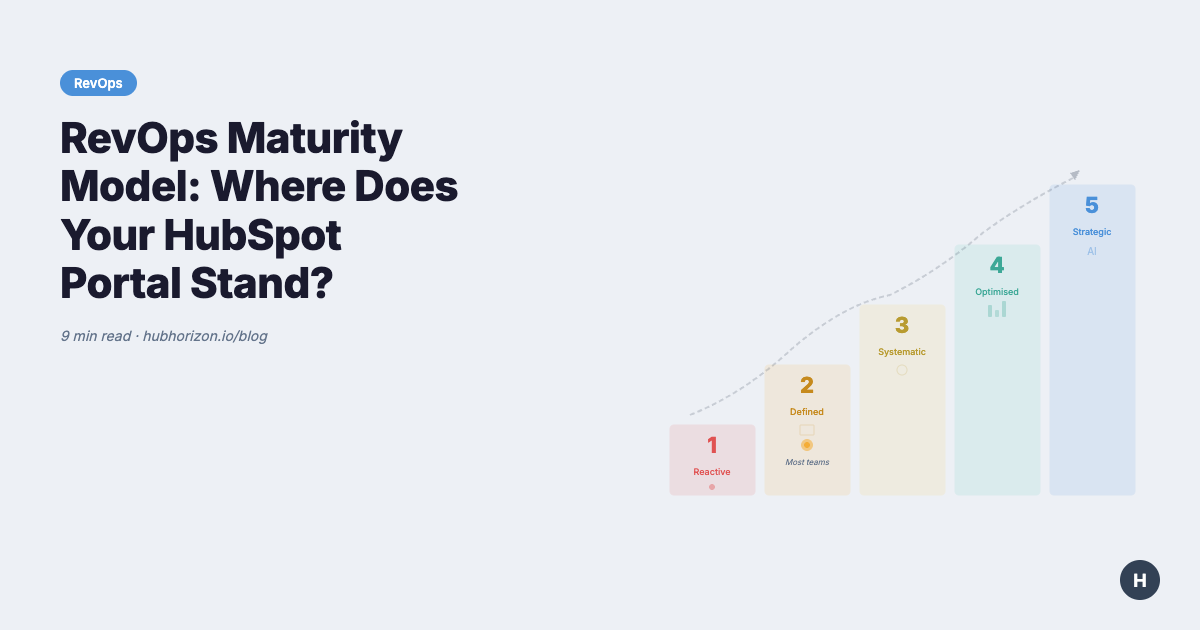
RevOps Maturity Model: 5-Level Assessment Framework for HubSpot Portals
A 5-level RevOps maturity model for HubSpot portals. Self-assessment framework covering process, data, technology, and people dimensions — with practical steps to advance.

Peter Sterkenburg
HubSpot Solutions Architect & Revenue Operations expert. 20+ years B2B SaaS experience. Founder of HubHorizon.
Revenue Operations (RevOps) has gone mainstream. But maturity varies wildly — from teams still running everything in spreadsheets to organizations where AI models forecast revenue automatically.
This guide introduces a practical RevOps maturity model designed for HubSpot portals, so you can figure out where you are and what to improve next.
What is RevOps maturity?
RevOps maturity is a framework that measures how well your organisation aligns people, processes, data, and technology across sales, marketing, and customer success to drive predictable revenue. Most organisations progress through five levels — from ad hoc (siloed teams, no standards) to optimised (predictive, fully integrated) — and most HubSpot portals sit at Level 2-3.
The maturity model evaluates four dimensions:
- Process Alignment: How well your revenue processes are documented, standardized, and cross-functionally integrated
- Data Governance: The quality, consistency, and strategic use of your revenue data — governance sits above the other quality layers — it sets the policies that drive data integrity and the six measurable quality dimensions
- Technology Utilization: How effectively you leverage HubSpot and your broader tech stack
- Team Structure: The organizational design, skills, and collaboration patterns of your revenue teams
The five levels of RevOps maturity
Level 1: Ad Hoc
Characteristics: Revenue operations are reactive and fragmented. Teams work in silos with minimal coordination.
Process Alignment
- No documented processes or playbooks
- Each team (sales, marketing, CS) operates independently
- Handoffs between teams are informal and inconsistent
- Lead routing is manual or based on simple round-robin logic
- Deal stages vary by rep with no enforcement
Data Governance
At this level, none of the core data quality dimensions — accuracy, completeness, consistency, validity, uniqueness, timeliness — are systematically measured.
- Duplicate records are common across objects
- Property naming is inconsistent (e.g., "Company_Name", "CompanyName", "Org Name")
- Required fields are rarely enforced
- Data entry is voluntary, leading to 40-60% incomplete records
- No regular data hygiene practices
Technology Utilization
- HubSpot is used primarily as a contact database
- Native features like workflows, scoring, and reporting are underutilized
- Integration with other tools is minimal or non-existent
- Users lack training on platform capabilities
- Custom properties are created without strategy (often 200+ unused properties)
Team Structure
- No dedicated RevOps role; operations tasks fall to sales managers or marketing coordinators — this is the firefighting trap in its earliest form
- Each department maintains its own spreadsheets and shadow systems
- Cross-functional meetings are rare
- Metrics and KPIs differ by team with no unified dashboard
Indicators You're at Level 1:
- Sales reps complain about "garbage data" in the CRM
- Marketing can't accurately attribute pipeline to campaigns
- Customer success lacks visibility into pre-sale conversations
- Leadership relies on manual reports compiled from multiple sources
- Your HubSpot portal has evolved organically over years without strategic oversight
Level 2: Foundational
Characteristics: Teams recognize the need for coordination and start establishing basic standards.
Process Alignment
- Basic lead lifecycle stages are defined (MQL, SQL, Opportunity)
- Simple lead routing rules direct inbound leads to appropriate reps
- SLAs exist for key handoffs (e.g., marketing to sales) but aren't always followed
- Win/loss criteria are documented but interpretation varies
- Deal stages are standardized with exit criteria defined
Data Governance
- Critical fields are identified and made required (company name, deal amount, close date)
- Duplicate detection rules are enabled for Contacts and Companies
- Basic data validation (email format, phone number structure) is in place
- Monthly or quarterly data cleanup efforts occur
- Property naming conventions are documented but not always enforced
Technology Utilization
- Workflows automate simple tasks (lead assignment, task creation, follow-up reminders)
- Basic reporting dashboards track core metrics for each team
- Lead scoring model exists using demographic and behavioral data
- Key integrations are in place (email, calendar, maybe one or two specialized tools)
- Teams receive initial HubSpot training upon onboarding
Team Structure
- One person (often part-time) is designated as the "HubSpot admin"
- Weekly cross-functional meetings bring sales, marketing, and CS together
- Shared revenue goals are discussed but teams still optimize for departmental metrics
- Basic documentation exists for common procedures
- Request intake process exists (email or shared spreadsheet) for system changes
Indicators You're at Level 2:
- You have a lead scoring model, even if it needs refinement
- Reports exist but require manual interpretation and correlation
- Data quality is inconsistent but improving
- Teams agree on what an MQL is (most of the time)
- You've started measuring conversion rates between lifecycle stages
Level 3: Defined
Characteristics: RevOps is a recognized function with documented, standardized processes and meaningful automation.
Process Alignment
- End-to-end revenue process is mapped from first touch to renewal/expansion
- Playbooks exist for key scenarios (inbound qualification, outbound prospecting, onboarding, renewal)
- SLAs are monitored with automated alerts for violations
- Attribution model is defined (first-touch, last-touch, or multi-touch)
- Forecasting methodology is documented and consistently applied
- Deal desk or revenue operations team reviews complex deals
Data Governance
Organizations at this level are measuring most of the six core data quality dimensions and tracking them as KPIs.
- Comprehensive data dictionary defines every property, its purpose, and acceptable values
- Automated workflows enforce data quality rules and flag anomalies
- Regular deduplication runs are scheduled and monitored
- Data retention policies are documented and implemented
- Role-based access controls limit who can edit critical fields
- Data quality metrics are tracked (completeness %, duplicate rate, decay rate)
Technology Utilization
- Advanced HubSpot features are actively used (sequences, calculated properties, custom reports)
- Bi-directional sync with 5+ integrated tools maintains data consistency
- Revenue intelligence tools enhance forecasting and conversation insights
- Marketing automation leverages behavioral triggers and multi-step nurture programs
- Custom Objects extend HubSpot to track business-specific entities
- Regular platform optimization reviews identify underutilized features
Team Structure
- Dedicated RevOps team (2-4 people) with defined roles (operations analyst, systems admin, strategy)
- Clear ownership for cross-functional processes
- Shared OKRs align all revenue teams to common objectives
- Monthly business reviews analyze performance against revenue metrics
- Change management process governs system modifications
- Center of Excellence provides training and best practices
Indicators You're at Level 3:
- Sales, marketing, and CS work from a unified dashboard
- You can trace the customer journey from anonymous visitor to renewed customer
- Data quality scores consistently exceed 85%
- Forecasts are typically within 10% of actual results
- New hires follow documented onboarding playbooks
- System changes are logged, tested, and communicated systematically
Level 4: Managed
Characteristics: RevOps is a strategic partner to leadership. Data-driven decisions are the default across all revenue functions.
Process Alignment
- Continuous process improvement methodology (e.g., Six Sigma, Kaizen) is applied to revenue operations
- Processes dynamically adapt based on segment, product line, or customer type
- Closed-loop feedback connects outcomes to activities throughout the funnel
- Predictive analytics inform resource allocation and territory planning
- Customer health scoring drives proactive retention efforts
- Account-based strategies coordinate marketing, sales, and CS around high-value targets
Data Governance
- AI-powered data enrichment automatically appends firmographic and technographic data
- Predictive lead scoring models are trained on historical conversion data
- Master data management ensures single source of truth across systems
- Privacy compliance (GDPR, CCPA) is automated with consent tracking and data residency controls
- Real-time data quality dashboards are monitored by operations team
- Data stewards in each department ensure domain-specific accuracy
Technology Utilization
- HubSpot is the system of record for all revenue data
- Advanced attribution modeling provides granular campaign ROI insights
- Conversation intelligence transcribes and analyzes sales calls for coaching opportunities
- Revenue forecasting uses AI models trained on historical patterns
- Customer 360 view aggregates data from support, product usage, billing, and CRM
- API integrations enable custom workflows between specialized tools
- A/B testing platforms optimize email, landing pages, and sales messaging
Team Structure
- RevOps function includes specialized roles: data analyst, operations engineer, enablement manager, strategy lead
- Embedded operations support within each revenue team
- Cross-functional tiger teams address strategic initiatives (new product launch, market expansion)
- Board-level reporting on revenue operations metrics
- Investment in operations tools and headcount scales with revenue
- Career development paths attract and retain top operations talent
Indicators You're at Level 4:
- Your RevOps team is invited to executive strategy sessions
- Forecasts are accurate within 5% consistently
- Data quality exceeds 95% across critical objects
- You can model the revenue impact of process changes before implementing them
- Reps spend 70%+ of their time on revenue-generating activities
- Customer lifetime value and churn are predictable and improving
Level 5: Optimized
Characteristics: RevOps is embedded in how the company operates. Continuous optimisation is the default.
Process Alignment
- Real-time process monitoring identifies bottlenecks and triggers automated remediation
- Processes self-optimize using machine learning based on conversion outcomes
- Scenario planning models test strategic decisions before execution
- Revenue architecture supports multiple business models (transactional, subscription, usage-based)
- Expansion and cross-sell motions are as refined as new customer acquisition
- Partner ecosystem is integrated into revenue operations
Data Governance
All data quality dimensions are monitored autonomously — accuracy, completeness, consistency, validity, uniqueness, and timeliness are measured continuously without manual audits.
- Autonomous data quality: AI identifies and resolves anomalies without human intervention
- Predictive models anticipate customer needs, churn risk, and expansion opportunities
- Data mesh architecture enables domain-specific ownership with centralized governance
- Real-time data streaming supports instantaneous insights
- Advanced privacy controls support global compliance with minimal friction
- Data becomes a strategic asset informing product development and market strategy
Technology Utilization
- Composable architecture allows rapid adoption of best-in-class tools
- Low-code/no-code platforms enable business users to build custom solutions
- AI copilots assist reps with next-best actions, email drafting, and objection handling
- Revenue operations platform unifies planning, execution, and analysis
- Experimentation framework runs continuous tests across all revenue touchpoints
- Open APIs enable ecosystem partners to build on your data infrastructure
Team Structure
- RevOps is a strategic function reporting to CEO or President
- Operations teams exist for each revenue motion (acquisition, expansion, retention, partnerships)
- Data science team builds proprietary models for revenue optimisation
- Innovation team evaluates new tools before company-wide rollout
- Playbooks and frameworks are documented well enough to onboard new hires in days
Indicators You're at Level 5:
- Revenue per employee exceeds industry benchmarks by 50%+
- Customer acquisition cost has decreased while lifetime value increased year-over-year
- New product launches follow repeatable playbooks with predictable outcomes
- Operations team size scales sub-linearly with revenue growth
- You're not just using AI—you're building proprietary AI models for revenue optimization
The four dimensions scorecard
To accurately assess your maturity level, evaluate yourself across all four dimensions. Most organizations don't progress uniformly—you might be Level 3 in Data Governance but Level 2 in Process Alignment.
Process Alignment Indicators:
- Revenue processes are documented and accessible to all teams
- SLAs are defined, measured, and enforced for key handoffs
- Playbooks exist for common scenarios and edge cases
- Attribution model is implemented and trusted by leadership
- Forecasting follows a consistent methodology with regular accuracy reviews
- Continuous improvement culture drives regular process optimization
Data Governance Indicators:
- Data dictionary defines every property with clear ownership
- Duplicate rate is below 5% across all objects
- Critical fields have 90%+ completion rates
- Automated workflows maintain data quality in real-time
- Regular data audits identify and resolve systemic issues
- Privacy compliance is automated and auditable
Technology Utilization Indicators:
- HubSpot features are actively used (>60% of available tools in your subscription)
- Integrations maintain bi-directional sync with minimal errors
- Users are trained and certified on core platform capabilities
- System performance is monitored (page load times, API limits, workflow errors)
- Technology stack is rationalized (no redundant or unused tools)
- Platform roadmap aligns with business strategy
Team Structure Indicators:
- Dedicated RevOps headcount exists (not just fractional roles)
- Clear RACI matrix defines accountability for revenue processes
- Shared goals unite sales, marketing, and customer success teams
- Regular cross-functional meetings drive alignment
- Change management process governs system and process modifications
- Career paths and skill development programs support operations talent
Self-assessment: Where does your portal stand?
Use this framework to score your current maturity:
Step 1: For each dimension (Process, Data, Technology, Team), read the descriptions at each level and identify which best describes your current state.
Step 2: Assign a numerical score (1-5) based on the level you identified.
Step 3: Calculate your average score across all four dimensions.
Step 4: Plot your scores to identify strengths and gaps.
Interpretation:
- 1.0-1.9: Ad Hoc - Focus on foundational practices and quick wins
- 2.0-2.9: Foundational - Standardize processes and improve data quality
- 3.0-3.9: Defined - Optimize technology usage and formalize the RevOps function
- 4.0-4.9: Managed - Leverage advanced analytics and strategic initiatives
- 5.0: Optimized - Drive continuous innovation and industry leadership
Most organizations fall between Level 2 and Level 3, with uneven progress across dimensions. This is normal—use the gaps as your roadmap.
Practical steps to advance your maturity
Regardless of your current level, these principles accelerate progress:
Start with data quality: Nothing else matters if your data is unreliable. Audit your data, clean up duplicates and incomplete records, then automate ongoing maintenance. Data quality also determines whether your CRM can power AI tools — see our guide on HubSpot AI readiness for the 6-pillar assessment framework.
Document before automating: You can't automate chaos. Map current-state processes, identify inefficiencies, then design future-state processes before building workflows.
Align on definitions: Create a shared revenue vocabulary. What's an MQL? When is a deal "Closed Won"? How do you attribute revenue? Get cross-functional agreement in writing.
Build incrementally: Don't try to jump from Level 1 to Level 5. Focus on mastering your current level before advancing. Consolidate wins before adding complexity.
Measure what matters: Define 5-10 core metrics that truly drive revenue (not vanity metrics). Ensure everyone can access these metrics and understands how their work impacts them.
Invest in your people: Technology doesn't run itself. Build operations competency through training, certification, and hiring. Good operations people make everything else work better.
How HubHorizon automates maturity assessment
Manual assessment is subjective and time-consuming. HubHorizon analyzes your HubSpot portal to objectively score your RevOps maturity across all four dimensions.
The platform evaluates over 50 indicators including:
- Property utilization and naming consistency
- Workflow complexity and error rates
- Data completeness and duplicate rates
- Integration health and sync reliability
- User adoption and feature utilization
- Process documentation coverage
Within minutes, you receive a maturity scorecard showing your current level, your strongest dimension, and specific areas to improve — based on your actual portal configuration and usage patterns.
Frequently Asked Questions
What is RevOps maturity?
RevOps maturity is a measure of how well an organisation aligns people, processes, data, and technology across sales, marketing, and customer success to drive predictable revenue. It's typically assessed across five levels — from ad hoc (siloed teams, no standards) to optimised (predictive, fully integrated). Most HubSpot portals sit at Level 2-3.
How do I assess my RevOps maturity level?
Score your organisation across four dimensions: process alignment, data governance, technology utilisation, and team structure. Rate each 1-5 based on the level descriptions in this article. Your overall maturity level is determined by your lowest-scoring dimension — a chain is only as strong as its weakest link. For an automated assessment, HubHorizon scores these dimensions by analysing your actual portal data.
What's the difference between RevOps maturity levels 2 and 3?
Level 2 (Emerging) means basic alignment exists — teams share some tools and metrics, but processes are inconsistent and data governance is reactive. Level 3 (Defined) means documented processes, shared KPIs, proactive data quality management, and a dedicated RevOps function. The jump from 2 to 3 is where most organisations stall because it requires governance investment that doesn't show immediate revenue impact.
Do I need to reach Level 5 RevOps maturity?
No. Level 5 (Optimised) involves predictive analytics, real-time cross-functional orchestration, and fully automated revenue intelligence. Few organisations reach it, and most don't need to. What matters is that your maturity matches your growth stage. A Series A company at Level 3 with strong data governance is better positioned than a Series C company at Level 4 with weak fundamentals.
Most teams don't need Level 5
Few organizations reach Level 5 — and most don't need to. A Series A startup doesn't need the same operations sophistication as a publicly-traded enterprise. What matters is that your RevOps maturity matches your growth stage.
Use this model as a compass, not a report card. Focus on the gaps between your four dimension scores. Those gaps tell you where to invest next.
Ready to see where your HubSpot portal stands? HubHorizon scores your portal across all four dimensions and shows you a prioritized improvement roadmap.
Start your free maturity assessment at hubhorizon.io — view pricing plans for full RevOps scoring, methodology alignment, and continuous trend tracking.
Peter Sterkenburg is the founder of HubHorizon, a HubSpot portal health and optimization platform. He works with B2B companies to build scalable revenue operations.
Related articles
The HubSpot Pipeline Management Cheat Sheet: Views, Signals, and Reviews in One Place
One-page HubSpot pipeline reference: 6 deal health signals, warning thresholds, 9 saved view recipes, stage design checklist, and review prep guide.
Read articleYour HubSpot Pipeline Is a Data Structure. Most Are Broken.
Your deal pipeline is a data structure. When stages, exit criteria, and required properties break, forecasting and AI produce garbage. Diagnose and fix it.
Read articleWhy Your HubSpot Sales Forecast Is Wrong — and It's Not a Process Problem
Most forecasting failures are data failures, not process failures. Diagnose and fix the data foundation your HubSpot forecast depends on.
Read article