

How to Break Out of the RevOps Firefighting Trap
Practical playbook for RevOps teams stuck in reactive mode: intake systems, prioritisation frameworks, and foundation-first sequencing.

Peter Sterkenburg
HubSpot Solutions Architect & Revenue Operations expert. 20+ years B2B SaaS experience. Founder of HubHorizon.
I recently wrote about why RevOps teams in scale-ups can't build foundations while fighting fires. The entropy that hits all four pillars simultaneously. The structural trap where the work required to escape consumes the same bandwidth the trap demands.
The response from RevOps people I shared it with told me the same thing: "yeah, that's us. Now what?"
This is the "now what." Four changes that actually move the needle. Some I learned through painful trial and error. Others I picked up from watching teams that cracked it. None of them are revolutionary. All of them are hard to execute when you're underwater, which is why they require deliberate sequencing.
Stop the bleed: Build an intake system
The first problem to solve isn't data quality. It isn't process documentation. It's uncontrolled demand.
When anyone in the company can Slack the RevOps team with an "urgent" request, everything is urgent and nothing gets prioritised. The VP who needs a dashboard by Thursday competes with the SDR manager who wants a new lead status field and the CS director who needs a churn workflow. Without a system, the loudest voice wins. Or the most senior voice. Or whoever catches the RevOps person between meetings.
I spent my first year in operations responding to requests as they came in. I thought I was being responsive. I was actually teaching the organisation that RevOps has no capacity limits, that we'll always absorb one more thing. The backlog grew. The strategic work never started.
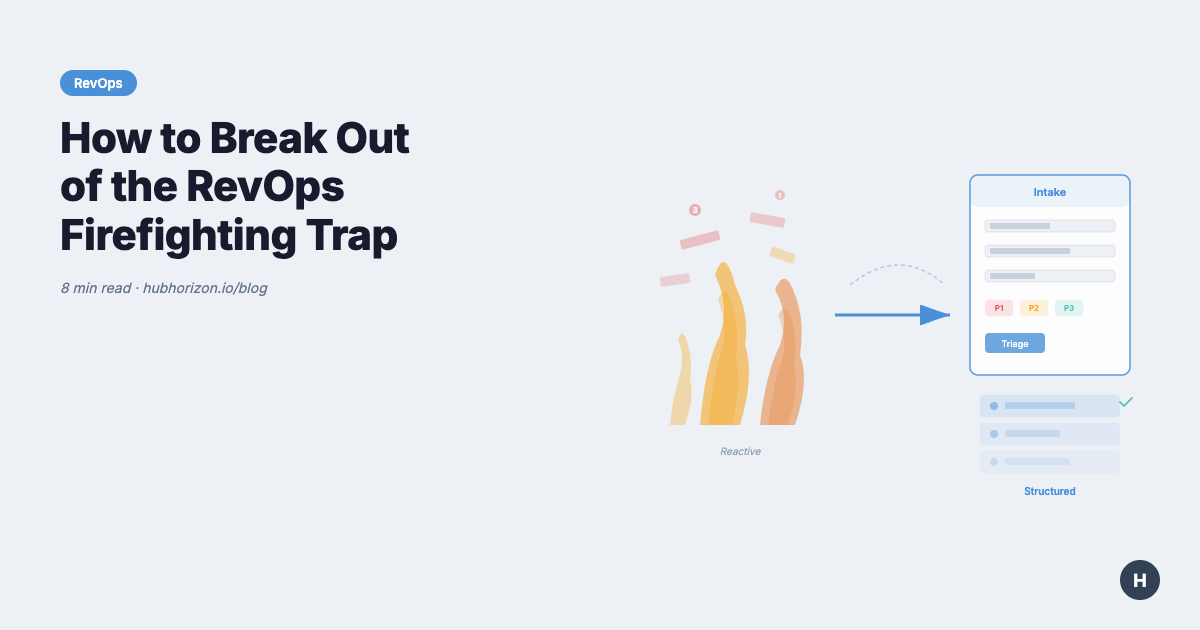
The fix is almost comically simple: a centralized intake form.
It doesn't matter whether it's a Jira service desk, an Asana form, a Notion database, or a Google Form feeding a spreadsheet. The tool matters far less than the discipline. What matters are four things:
A single entry point. No more Slack DMs, hallway conversations, or "quick questions" that turn into two-week projects. Everything goes through the form. This is the hardest cultural change to enforce, and it's the most important one.
Structured fields. What do you need? Who is it for? What business outcome does it support? What's the real deadline? Forcing requesters to answer these questions upfront eliminates at least 20% of requests, because some people realise their ask isn't worth the effort of filling out a form.
A triage cadence. Weekly review, not real-time reaction. The RevOps team reviews incoming requests every Monday, prioritises against current work, and communicates timelines. Urgent exceptions exist, but they're exceptions, not the default operating mode.
Visible status. Requesters can see where their ask sits in the queue. This transparency alone reduces "where's my thing?" follow-ups by half and makes capacity constraints real instead of abstract.
ZoomInfo's RevOps team implemented a centralized stack-ranking system where company goals sit at the top, followed by CRO-level priorities, then individual SVP requests, all visible in one view. Monthly stakeholder reviews keep alignment current. The result: RevOps works above capacity, but only on what matters most.
The shift sounds small. It isn't. You're moving from "RevOps responds to whoever asks loudest" to "RevOps works on what drives the most business impact, and everyone can see why."
Prioritise by impact, not urgency
An intake system collects requests. It doesn't tell you which ones to do first.
Most RevOps teams default to urgency as the sorting mechanism. What's on fire right now? What's blocking a deal? Who's the most frustrated stakeholder? This feels productive. You're solving real problems in real time. But it guarantees you never work on the infrastructure that would prevent those fires from starting.
The framework I've seen work best is simple: a two-axis evaluation. Business impact on one axis. Effort on the other. High impact, low effort moves first. Low impact, high effort gets pushed to the backlog or declined entirely.
The real unlock isn't the matrix itself. It's forcing requesters to articulate business impact before RevOps estimates effort. "I need a new custom property" isn't a request. It's a solution without a stated problem. "I need to track whether prospects attended our webinar so we can measure event-driven pipeline" is a request with business context. Some asks dissolve entirely when the requester has to connect them to an outcome.
Every month, sit down with your key stakeholders and re-rank priorities together. Bring a capacity model, even a rough one. "We have approximately 80 hours of RevOps capacity this month. Here are the 10 requests in the queue, estimated at 120 hours total. Help us choose which 6-7 get done."
This conversation is uncomfortable the first time. It forces stakeholders to compete for a finite resource instead of assuming infinite availability. But it accomplishes something no amount of late nights can: it makes leadership responsible for what gets prioritised, not just RevOps.
The cultural shift is significant. RevOps stops being a service desk with infinite bandwidth and starts being a strategic function with finite capacity that must be directed at the highest-leverage work.
Foundation first: The right sequencing
This is where most scale-ups go wrong: they try to solve the chaos by adding technology. A new automation platform. An AI enrichment tool. A data orchestration layer. Maybe all three at once. The logic feels sound: automate the manual work, and you'll free up time for strategic initiatives.
It doesn't work when the foundation is broken.
Tessa Whittaker at ZoomInfo built a maturity scale from 0 to 5 for RevOps readiness. If you've taken a RevOps maturity assessment, you'll recognise the pattern. AI doesn't enter the picture until Level 3, after manual processes are defined and systematised. Levels 0 through 2 are all about getting the basics right: documented workflows, clean data definitions, assigned ownership.
The sequencing matters:
1. Data governance. Define property naming conventions. Establish which fields are required and why. Measure the six data quality dimensions (accuracy, completeness, consistency, validity, uniqueness, timeliness). Clean the worst offenders. This is foundational work with compounding returns.
2. Process documentation. Map your current-state revenue processes. Not the idealised version in last year's strategy deck. The real version, with all the exceptions and workarounds. Identify the three biggest gaps between current-state and what the business actually needs. Document the future-state for those three. Only three. Don't try to fix everything.
3. Automation. Only automate processes that are documented and working manually. If you automate a broken process, you get a broken process that runs faster. As Matt Lauer put it in a conversation about building RevOps from scratch: "You need a good foundation for data and a good foundation for processes that feed that data." Tools don't fix data. They consume it.
4. AI and machine learning. Only layer intelligence on data you trust. If your AI readiness scores are low (incomplete records, inconsistent categorical values, poor association health), AI tools will produce confidently wrong outputs.
The fastest tactical win in this sequence is a property hygiene audit. It costs nothing, takes a few hours, and immediately reveals how much organic sprawl has accumulated. Unused properties, inconsistent naming, fields that duplicate other fields. Cleaning this up improves data quality and makes the CRM less intimidating for everyone who uses it.
Earn strategic credibility
The catch-22 every RevOps team faces: you need strategic influence to get investment in foundations, but you won't earn strategic influence while stuck doing tactical work.
Breaking this cycle requires changing what you deliver, not just how hard you work.
Deliver insights, not reports. Don't present "pipeline is $4M." Present "pipeline is $4M, but 40% of those Deals haven't been touched in 14+ days. If we apply our historical conversion rates to the healthy portion, realistic coverage is closer to 1.2x. Here's what that means for the quarter, and here's what would need to change to close the gap." The first version is data. The second is intelligence. Leadership pays attention to the second.
Make data quality visible with actual numbers. Most stakeholders have no idea how bad the data is because nobody quantifies it. When a VP sees that the contact completeness rate feeding their forecasting model is 62%, the conversation about investing in data governance becomes a lot easier. A data quality audit gives you these numbers.
Propose trade-offs, not problems. Instead of "we're overwhelmed," present "we can build the three new reports you asked for this month, or we can fix the data quality issues that make all our reports unreliable. Option A gives you three new views of unreliable data. Option B gives you reliable data in every existing view. Which is more valuable?" Frame the choice. Let leadership choose.
The RevOps team that earns a seat at the leadership table translates operational health into business outcomes. "Our duplicate rate increased 4% this quarter" is an ops metric. "We're sending 4% more emails to the same people, which means our engagement rates are artificially depressed and we're burning sender reputation" is a business problem leadership cares about.
Jeff Ignacio, Director of RevOps at Upkeep, describes the shift this way: stop reporting "what is" and start explaining "so what." The data doesn't change. The framing does. And the framing is what earns the credibility to invest in foundations.
Automate monitoring, not just workflows
Once you've established intake, prioritisation, and governance, you need a way to know whether the foundation holds.
Manual audits happen quarterly at best. In a scale-up, the CRM changes daily. Fifty people modify records, create properties, run imports, adjust workflows. By the time you run your next manual audit, three months of drift have accumulated. You're always reacting to damage that already happened.
This is the gap that led me to build HubHorizon. Automated, continuous monitoring of data quality, property hygiene, association health, and AI readiness, the things that decay silently between audits. The RevOps team gets a composite health score and per-dimension breakdowns without adding another manual process to their overloaded plate.
But the principle holds regardless of the tool you use. Measure the six data quality dimensions regularly. Track them as KPIs. Put them on a dashboard that stakeholders can see. When data quality is visible and measured, it stays maintained. When it's invisible, it decays.
The RevOps teams that break out of the firefighting trap share one thing: they made the invisible visible before something broke. They didn't wait for a failed forecast or a botched campaign to expose the foundation problems. They measured, reported, and used that visibility to earn the mandate for structural improvement.
Start with one
The firefighting trap is structural, but it's not permanent. The four changes (intake, prioritisation, foundation-first sequencing, and continuous monitoring) don't require more headcount. They require different operating discipline.
You don't need to implement all four at once. Start with the one that would make the biggest immediate difference for your team. For most, that's the intake system, because controlling demand is a prerequisite for everything else. You can't prioritise what you can't see. You can't sequence work you haven't triaged.
Pick one. Implement it. Measure whether it shifts the ratio of reactive to proactive work. Then move to the next.
The trap breaks one structural change at a time.
Frequently Asked Questions
How do you prioritise RevOps requests?
Effective prioritisation uses two axes: business impact and effort. High-impact, low-effort work moves first; low-impact, high-effort work gets pushed or declined. The critical step most teams skip is requiring requesters to articulate business impact before RevOps estimates effort — this dissolves at least a portion of incoming requests, because "I need a new custom property" is not a prioritisable request, but "I need to track webinar attendance to measure event-driven pipeline" is. Every month, run a prioritisation session with key stakeholders where you show total available capacity against the full queue and ask leadership to choose what gets done. This makes trade-offs visible and shifts accountability for prioritisation decisions away from RevOps alone.
What is a RevOps intake system?
A RevOps intake system is a centralised, structured process for capturing all work requests before any work begins. The tool is secondary — a Jira service desk, a Notion database, or even a Google Form feeding a spreadsheet all work. What matters is a single entry point that replaces Slack DMs and hallway conversations, structured fields that force requesters to state the business outcome and real deadline, a weekly triage cadence rather than real-time reaction, and visible queue status so requesters know where their ask sits. ZoomInfo's RevOps team implemented a stack-ranking system where all requests are visible in one view, reviewed monthly with stakeholders, keeping RevOps focused on work tied to the highest-priority company goals.
How do you build foundations while fighting fires in RevOps?
The key is sequencing: data governance first, then process documentation, then automation, then AI and intelligence tooling. Attempting to automate an undocumented or broken process encodes the confusion into software — automation amplifies whatever system already exists, clean or messy. In practice, the fastest tactical entry point is a property hygiene audit, which takes a few hours, costs nothing, and immediately reveals accumulated sprawl that is slowing everyone down. From there, define your minimum data quality standards, measure current state, and build the case for structured foundation work as a line item, not a side project absorbed into reactive capacity.
How do you get leadership buy-in for CRM data quality?
Translate operational metrics into business consequences. "Our contact completeness rate is 62%" does not move a leadership conversation. "The data feeding our forecasting model is 62% complete, which means our pipeline accuracy number carries a 38% blind spot" does. Show the cost of bad data in terms leadership tracks: forecast accuracy, campaign performance, rep productivity, AI tool reliability. A data quality audit gives you the specific numbers — fill rates, duplicate counts, association gaps — to make the invisible visible. When stakeholders can see that their team's unvalidated import dropped completeness by eight points and introduced hundreds of duplicates, the conversation about intake discipline changes.
Start your free portal health check at hubhorizon.io — see where your data quality, property hygiene, and CRM foundations stand today. View pricing plans for continuous monitoring that keeps the foundation visible between audits.
Peter Sterkenburg is the founder of HubHorizon, a HubSpot portal health and optimization platform. He's spent years in scale-up RevOps — building the systems, fighting the fires, and eventually building the tool he wished he'd had.
Related articles
The HubSpot Pipeline Management Cheat Sheet: Views, Signals, and Reviews in One Place
One-page HubSpot pipeline reference: 6 deal health signals, warning thresholds, 9 saved view recipes, stage design checklist, and review prep guide.
Read articleYour HubSpot Pipeline Is a Data Structure. Most Are Broken.
Your deal pipeline is a data structure. When stages, exit criteria, and required properties break, forecasting and AI produce garbage. Diagnose and fix it.
Read articleWhy Your HubSpot Sales Forecast Is Wrong — and It's Not a Process Problem
Most forecasting failures are data failures, not process failures. Diagnose and fix the data foundation your HubSpot forecast depends on.
Read article