

CRM Health Score Explained: What It Is, How It's Calculated, and Benchmarks
What is a CRM health score? How it's calculated, what counts as a good score (with benchmarks), and how to improve yours. Includes a breakdown of the 5 core components.

Peter Sterkenburg
HubSpot Solutions Architect & Revenue Operations expert. 20+ years B2B SaaS experience. Founder of HubHorizon.
Your CRM contains the data that drives every revenue process you run. But most teams don't know whether that data is helping or hurting. Incomplete records and broken associations silently cost opportunities, and nobody notices until a forecast misses or an automation fires on the wrong segment.
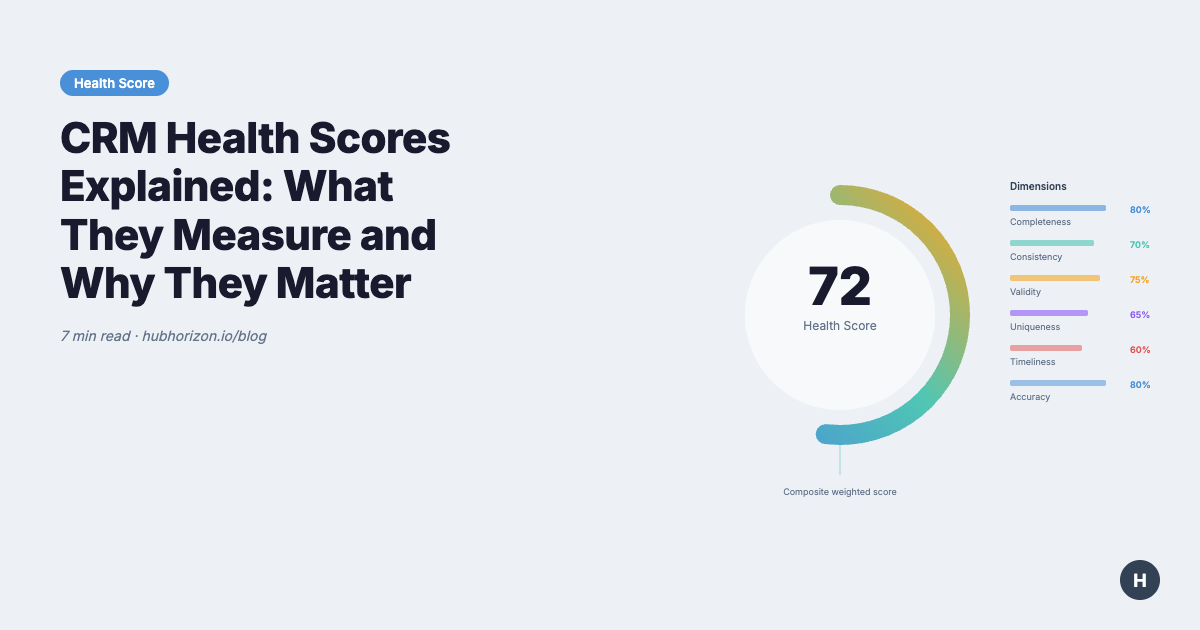
A CRM health score gives you a quantifiable answer. It aggregates data quality and configuration signals into a single number — think of it as a credit score for your database.
Here's what CRM health scores measure, how they're calculated, what counts as a good score, and how to improve yours.
What is a CRM health score?
A CRM health score is a composite rating (typically 0-100) that measures data completeness, property hygiene, association quality, and configuration effectiveness across your CRM. It aggregates multiple data quality signals into a single number — like a credit score for your database — so you can quantify CRM condition instead of guessing.
Unlike vanity metrics that simply count records or properties, a health score measures whether your CRM is actually set up to support your business processes, enable accurate reporting, and power automation and AI tools.
Why CRM health scores matter
Poor CRM health has concrete business consequences:
- Lost revenue: Sales reps waste 20-30% of their time searching for information or correcting data errors
- Bad decisions: Executives make strategic calls based on incomplete or inaccurate reports
- Wasted investment: Marketing automation and AI tools underperform when fed low-quality data
- Compliance risks: Missing or inconsistent data creates GDPR, CCPA, and other regulatory exposure
A health score helps you identify problems before they escalate into business-impacting issues. It provides a baseline for improvement efforts and a way to track progress over time. If you're not sure where to start, our step-by-step HubSpot data quality audit guide walks through the 10 key areas every audit should cover.
Core components of a CRM health score
Most health score systems evaluate components that align with the formal data quality dimensions — accuracy, completeness, consistency, validity, uniqueness, and timeliness. While different platforms group and weight them differently, the underlying dimensions are the same:
1. Data completeness (20-25% of score)
The completeness dimension — whether critical fields are populated across your records. Empty fields mean missed opportunities for segmentation, personalization, and analysis.
Key metrics:
- Percentage of Contacts with email addresses
- Percentage of Companies with industry classification
- Percentage of Deals with close dates and amounts
- Required custom field completion rates
Industry benchmark: Top-performing CRMs maintain 85%+ completion on critical fields.
2. Data accuracy (20-25% of score)
Accuracy is about whether stored values reflect reality — does the job title match the actual role, does the deal amount match the contract? This component evaluates whether your CRM data is correct and properly formatted.
Key metrics:
- Valid email format percentage
- Properly formatted phone numbers
- Consistent date formatting
- Realistic value ranges (no $0 Deals or 200-year-old Contacts)
Industry benchmark: High-quality CRMs keep formatting errors below 5%.
3. Data consistency (15-20% of score)
Covers two related data quality dimensions: consistency (whether related information aligns across your database) and uniqueness (whether records are free of duplicates). Inconsistent data and duplicate records both break reporting and automation.
Key metrics:
- Contact company alignment (does the contact's company field match an actual company record?)
- Deal-to-contact associations
- Cross-object value consistency (does the deal amount match the sum of Line Items?)
- Duplicate detection rates
Industry benchmark: Well-maintained CRMs have duplicate rates below 3% and association alignment above 90%.
4. Schema quality (15-20% of score)
This component maps to the validity dimension — whether data conforms to defined rules, formats, and types. It evaluates your CRM's structural setup — the properties, lifecycles, and pipelines that define how data flows.
Key metrics:
- Unused property ratio (properties created but never populated)
- Naming convention consistency
- Property description completeness
- Pipeline stage coverage and logic
Industry benchmark: Mature CRMs use 80%+ of their custom properties and maintain clear naming standards.
5. Data freshness (10-15% of score)
Data management practitioners call this the timeliness dimension — is data current enough to support decisions? Stale data leads to wasted outreach and missed opportunities.
Key metrics:
- Average time since last contact activity
- Percentage of records updated in the last 90 days
- Inactive contact ratio
- Sync status for integrated tools
Industry benchmark: Active CRMs update 60%+ of records quarterly.
6. Sensitive data management (5-10% of score)
Evaluates whether you're handling personal and confidential information appropriately.
Key metrics:
- PII storage in appropriate fields
- Encryption and access control implementation
- Compliance with data retention policies
- Audit trail completeness
Industry benchmark: Compliant CRMs flag and protect 100% of sensitive fields.
7. AI readiness (5-10% of score)
For modern CRMs, this measures whether your data can effectively power machine learning, predictive analytics, and automation. Our AI readiness scoring guide breaks this down into six measurable pillars.
Key metrics:
- Standardized categorization (industries, lead sources, etc.)
- Sufficient historical data volume
- Activity logging completeness
- Integration with AI-powered tools
Industry benchmark: AI-ready CRMs maintain standardized taxonomies and 12+ months of activity history.
How CRM health scores are calculated
The calculation methodology varies by platform, but most use a weighted average approach:
- Component scoring: Each dimension (completeness, accuracy, etc.) receives a 0-100 score based on its metrics
- Weighting: Dimensions are weighted by business impact (completeness and accuracy typically carry the most weight)
- Aggregation: Weighted scores are combined into a composite 0-100 health score
- Trending: Scores are tracked over time to show improvement or degradation
Example calculation
Let's say a HubSpot portal scores:
- Data Completeness: 72/100 (25% weight)
- Data Accuracy: 88/100 (25% weight)
- Data Consistency: 65/100 (20% weight)
- Schema Quality: 80/100 (15% weight)
- Data Freshness: 58/100 (10% weight)
- Sensitive Data Management: 95/100 (5% weight)
Overall Health Score = (72×0.25) + (88×0.25) + (65×0.20) + (80×0.15) + (58×0.10) + (95×0.05) = 74.55/100
This portal has solid accuracy and schema quality but needs improvement in consistency and freshness.
CRM health score benchmarks
Here's how to interpret your overall health score:
90-100: Excellent
Your CRM is in top shape. Data is complete, accurate, and well-structured. You're positioned to maximize ROI from automation and AI tools. Focus on maintenance and continuous improvement.
75-89: Good
Your CRM is functional but has room for improvement. You likely have pockets of incomplete or inconsistent data. Prioritize addressing the lowest-scoring components.
60-74: Fair
Significant data quality issues exist. Sales and marketing teams are probably experiencing friction. You need a structured improvement plan targeting multiple dimensions simultaneously.
Below 60: Poor
Your CRM has serious problems that are actively hurting business performance. Data-driven decisions are unreliable. This requires immediate attention and potentially professional cleanup services.
Industry context
Most CRM implementations accumulate technical debt over time. Common patterns we see:
- Portals with 100+ custom properties typically have 20-40% that are unused or redundant
- Association completeness (Contacts linked to Companies, Deals linked to Contacts) is often the lowest-scoring dimension
- Companies that run regular health audits see measurable improvements in reporting accuracy and automation reliability
The HubHorizon approach to health scoring
HubHorizon calculates health scores specifically for HubSpot CRMs. Here's how it differs from a generic approach:
50+ metrics across all objects
We analyze Contacts, Companies, Deals, Tickets, and Custom Objects — covering schema quality, data completeness, association health, configuration effectiveness, and AI readiness.
Weighted by business impact
Critical issues (missing required fields, broken associations) carry more weight than minor inconsistencies.
Context-aware scoring
A property that's unused isn't automatically bad — it might be intentionally retired. We analyze usage patterns, creation dates, and dependencies before flagging issues.
Prioritized fix list
Every score comes with specific recommendations ranked by impact. Not just "here's what's wrong" but "fix this first, then this."
Benchmark comparisons
Your score is compared against anonymized data from similar HubSpot portals (by industry, size, and complexity) so you know where you actually stand.
How to improve your CRM health score
Improving your health score requires a systematic approach:
1. Start with quick wins (Week 1)
- Fix formatting errors in email and phone fields
- Delete obviously duplicate records
- Complete critical empty fields for your top 20% of Contacts
- Archive unused custom properties
Expected impact: +5-10 points
2. Tackle data consistency (Weeks 2-4)
- Align contact-company associations
- Standardize lifecycle stage definitions
- Implement validation rules for new data entry
- Clean up cross-object inconsistencies
Expected impact: +10-15 points
3. Optimise your schema (Ongoing)
- Document property purposes and naming conventions
- Consolidate redundant properties
- Set up required fields enforcement
- Create data governance policies
Expected impact: +5-10 points
4. Maintain data freshness (Ongoing)
- Implement regular data enrichment workflows
- Set up activity logging automation
- Schedule quarterly data audits
- Archive inactive records systematically
Expected impact: +5-10 points
5. Enable AI readiness (Months 2-3)
- Standardize categorization fields
- Ensure sufficient historical data depth
- Implement comprehensive activity tracking
- Integrate AI-powered tools
Expected impact: +5-10 points
Most organizations can improve their score by 20-30 points within 90 days with focused effort.
Monitoring your score over time
A single health score is useful, but tracking trends is even more powerful:
- Monthly reviews: Check your score monthly to catch degradation early
- Pre/post-campaign analysis: Measure how major initiatives (imports, migrations, campaigns) impact health
- Team scorecards: Break down scores by object type or team responsibility
- Executive reporting: Include health score in leadership dashboards alongside revenue and pipeline metrics
Set improvement targets. If you're at 65 today, aim for 75 in 90 days and 85 in six months.
Common misconceptions about CRM health scores
"More data is always better": Wrong. A database of 100,000 poorly-maintained Contacts scores worse than 10,000 clean, complete records.
"Health scores are just for big companies": Small businesses benefit even more. Limited resources mean you can't afford inefficiency from bad data.
"Once you fix it, you're done": CRM health requires ongoing maintenance. Scores naturally degrade without active management.
"IT/Ops should own this alone": Health improvement requires collaboration across sales, marketing, customer success, and operations.
Your CRM health score is a business metric, not a technical one
A perfect score is neither realistic nor the point. What matters is whether your reports are trustworthy, your automation runs on clean data, and your AI tools produce useful output. That's what the score measures.
If you don't know your current score, you're flying blind. And if you do know it but aren't actively working to improve it, you're accepting avoidable inefficiency.
Frequently Asked Questions
What is a good CRM health score?
A CRM health score above 70 indicates a well-maintained system with strong data quality foundations. Scores between 50-70 suggest specific areas need attention — typically property hygiene or association completeness. Below 50 signals systemic issues that are likely affecting reporting accuracy, automation reliability, and AI tool performance.
How often should I check my CRM health score?
Monthly checks catch degradation early before it compounds. Quarterly is the minimum for any team serious about data quality. You should also run a health check after major changes — bulk imports, new integrations, CRM migrations, or team restructures — since these events frequently introduce data quality issues.
What's the difference between a CRM health score and a data quality audit?
A CRM health score is a composite metric — a single number that summarises overall system health. A data quality audit is the detailed investigation underneath, examining specific areas like property hygiene, duplicate rates, association completeness, and workflow dependencies. The health score tells you whether to worry; the audit tells you what to fix.
Can a CRM health score predict business outcomes?
Indirectly, yes. Portals with health scores above 70 consistently show better forecast accuracy, higher automation success rates, and more reliable AI outputs. The score doesn't predict revenue directly, but it predicts whether your CRM tools are working with good data — which directly affects every revenue process that depends on them.
See your CRM health score in minutes
HubHorizon analyzes your HubSpot portal and delivers a health score with specific recommendations in under 5 minutes.
You'll get:
- Overall health score (0-100) with component breakdowns
- Specific issues prioritized by business impact
- Step-by-step improvement recommendations
- Benchmark comparisons to similar organizations
- Exportable reports for stakeholder sharing
No setup, no technical skills required, and completely secure. Your data never leaves the HubSpot environment.
Analyze Your Portal Now → — see pricing plans for full diagnostics, AI readiness scoring, and exportable reports.
Run the analysis. See where the gaps are. Decide what to fix first.
Peter Sterkenburg is the founder of HubHorizon, a HubSpot portal health and optimization platform.
Related articles
The HubSpot Pipeline Management Cheat Sheet: Views, Signals, and Reviews in One Place
One-page HubSpot pipeline reference: 6 deal health signals, warning thresholds, 9 saved view recipes, stage design checklist, and review prep guide.
Read articleYour HubSpot Pipeline Is a Data Structure. Most Are Broken.
Your deal pipeline is a data structure. When stages, exit criteria, and required properties break, forecasting and AI produce garbage. Diagnose and fix it.
Read articleWhy Your HubSpot Sales Forecast Is Wrong — and It's Not a Process Problem
Most forecasting failures are data failures, not process failures. Diagnose and fix the data foundation your HubSpot forecast depends on.
Read article