

HubSpot AI Readiness Scoring: What It Measures and Why It Matters
How HubSpot AI readiness scores work: the 6-component framework, 5 maturity levels, and what your score means for Breeze AI.

Peter Sterkenburg
HubSpot Solutions Architect & Revenue Operations expert. 20+ years B2B SaaS experience. Founder of HubHorizon.
A client enabled Breeze Copilot last quarter and immediately noticed something odd. The email drafts it suggested for one segment of their pipeline were sharp and contextual. For another segment, the suggestions were vague and generic, sometimes referencing data that was months out of date.
Same tool. Same portal. Completely different quality of output.
The difference was the data behind each segment. The first segment had complete deal records, logged activities, and solid company associations. The second had sparse deal properties, almost no logged calls, and contacts that weren't linked to companies. Breeze was working exactly as designed — it just had nothing to work with for half the pipeline.
That's the problem an AI readiness score is built to surface. Not "is AI available in your portal" (it is, for everyone) but "will AI actually work well with your data?"
What is an AI readiness score?
An AI readiness score is a 0-100 composite rating that measures how well your HubSpot CRM data supports AI-powered features. It evaluates the structural quality of your data across six dimensions, each weighted by its importance to machine learning and AI tool performance.
This is different from a CRM health score, which measures overall CRM effectiveness including configuration and adoption. It's also different from a data quality score, which focuses on property-level hygiene (naming, descriptions, zombies, duplicates). The AI readiness score is specifically about whether AI tools can produce reliable outputs from your data.
Think of it as a compatibility check. Your portal might have perfect property naming and zero duplicates (high data quality score) but still fail AI readiness if your associations are broken or your activity data is sparse. AI tools need connected, complete, and active data — not just clean property definitions.
The 6 components
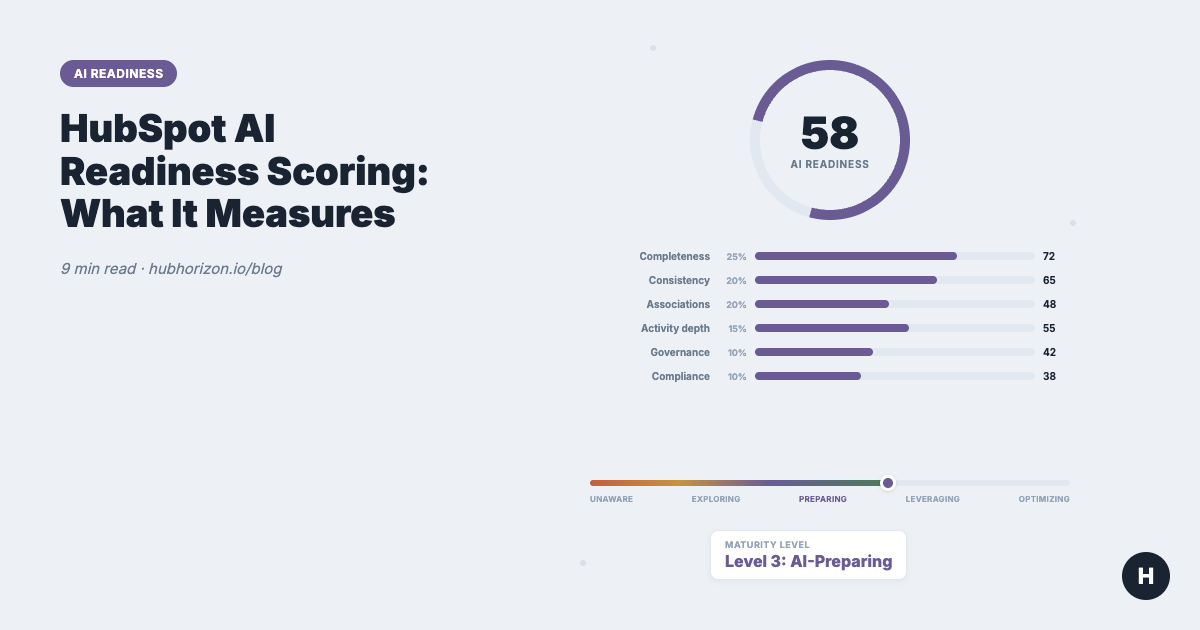
The AI readiness score is calculated from six components, each measuring a different aspect of AI-readiness. The weights reflect how much each component affects real-world AI tool performance.
1. Data completeness (25% weight)
Data completeness measures the fill rates of critical fields across your Contact, Company, Deal, and Ticket objects. It's the heaviest-weighted component because AI tools simply cannot infer missing information.
When 40% of your Contacts lack job titles, predictive lead scoring can't learn which roles convert. When half your Companies have no industry value, Breeze Intelligence can't segment by market. When Deals are missing amounts or close dates, forecasting models produce meaningless predictions.
What counts as "critical" varies by object:
- Contacts: email, job title, lifecycle stage, lead source, company association
- Companies: industry, company size, domain, annual revenue
- Deals: amount, close date, pipeline stage, associated contact, associated company
- Tickets: priority, category, associated contact
Score interpretation: 90%+ fill rates on critical fields = excellent. 70-89% = usable but with gaps. Below 70% = AI tools will underperform significantly.
2. Data consistency (20% weight)
Consistency measures whether the same concept is represented the same way across records. This covers two formal data quality dimensions: format consistency (phone numbers, dates, currencies all follow the same pattern) and value standardisation (industry values are clean picklist options, not 180 free-text variations of 20 industries).
AI models group records by shared attributes. If your industry field contains "SaaS," "Software as a Service," "SAAS," "Software," and "Tech / SaaS," the model treats these as five different industries instead of one. The result is fragmented segments and unreliable predictions.
What drives the score: standardised picklist usage, consistent formatting across text fields, logical alignment between related properties (lifecycle stage matches deal status, contact company matches deal company).
3. Association integrity (20% weight)
Association integrity measures how well your CRM records are linked to each other. In HubSpot, associations connect Contacts to Companies, Deals to Contacts, Deals to Companies, Tickets to Contacts, and so on. Broken or missing associations create orphan records that AI tools can't contextualise.
This component has the same weight as consistency because broken associations are one of the most damaging data problems for AI. A Contact without a Company association means Breeze Intelligence can't enrich the record by company. A Deal without associated Contacts means Copilot can't reference the buyer's history when suggesting emails.
What drives the score: Contact-to-Company association coverage, Deal-to-Contact coverage, Deal-to-Company coverage, Ticket-to-Contact coverage, and buying committee completeness (multiple contacts per deal).
4. Activity depth (15% weight)
Activity depth measures how much interaction data is logged in your CRM: emails sent and received, calls logged, meetings recorded, notes added. AI tools use activity history to understand engagement patterns, predict outcomes, and generate contextual recommendations.
A Contact record with 50 logged activities gives Copilot rich context for email drafts. A Contact record with zero activities forces Copilot to generate generic content based on the contact's name and job title alone.
What drives the score: average activities per record, percentage of records with at least one logged activity, recency of activity data (a portal with heavy activity 2 years ago but nothing recent scores lower than one with consistent recent logging).
5. Governance maturity (10% weight)
Governance maturity measures the structural discipline of your property schema: are properties documented with descriptions? Are naming conventions consistent? Are property groups organised logically? Is there evidence of intentional property lifecycle management (creation, usage, deprecation)?
This maps to the property hygiene dimension of CRM health. A well-governed property schema means AI tools can rely on semantic property names to understand what data means. A chaotic schema with temp_field_2, old_lead_score_v3, and 50 unused properties confuses AI models that try to infer meaning from field names and structures.
What drives the score: property description coverage, naming convention consistency, zombie property percentage, duplicate property groups, taxonomy organisation.
6. Compliance posture (10% weight)
Compliance posture measures whether your data handling practices support responsible AI usage. This includes sensitive data detection (PII stored in inappropriate fields), consent tracking (do you have opt-in/opt-out properties properly maintained?), and data retention practices.
This component has the lowest weight because it affects AI governance rather than AI performance, but it matters for responsible deployment. Running AI tools against data that includes unmanaged PII or outdated consent records creates compliance risk, especially in EU markets under GDPR.
What drives the score: sensitive data detection findings, consent property coverage, data retention evidence.
The 5 maturity levels
Your AI readiness score maps to one of five maturity levels. Each level describes what AI capabilities are realistic for your data quality.
| Level | Name | Score | What it means | AI capability |
|---|---|---|---|---|
| 1 | AI-Unaware | 0-25 | No data standards. Significant quality gaps. | AI features produce unreliable or unusable results |
| 2 | AI-Exploring | 26-45 | Basic standards exist. Some foundations established. | Basic AI assistance: email suggestions, simple summaries |
| 3 | AI-Preparing | 46-65 | Enforced standards. Solid foundation for AI experimentation. | Predictive lead scoring, Copilot summaries, basic Breeze features |
| 4 | AI-Leveraging | 66-82 | High-quality data enabling advanced AI features. | Full Breeze Intelligence, AI forecasting, prospecting agent |
| 5 | AI-Optimizing | 83-100 | Best-in-class data quality driving AI excellence. | AI agents operate autonomously with high accuracy |
Most portals we analyse fall in Levels 2-3 (scores 26-65). That's enough for basic AI features but not enough for the advanced capabilities that actually save time and generate revenue.
The jump from Level 3 to Level 4 (score 66+) is where AI becomes genuinely useful rather than a novelty. At Level 4, Breeze Intelligence enriches records reliably, forecasting models produce predictions worth acting on, and Prospecting Agent targets the right accounts. Below 66, these features work intermittently — sometimes useful, sometimes wrong, which is worse than not having them at all.
What the indicators look like at each level
Four operational metrics determine your maturity level alongside the composite score:
| Indicator | Level 1 | Level 2 | Level 3 | Level 4 | Level 5 |
|---|---|---|---|---|---|
| Critical field fill rate | < 50% | 50-70% | 70-85% | > 85% | > 95% |
| Duplicate rate | > 5% | 3-5% | 1-3% | < 1% | < 0.5% |
| Association coverage | < 40% | 40-60% | 60-80% | > 80% | > 90% |
| Activity score | < 30 | 30-50 | 50-70 | > 70 | > 80 |
These are the numbers that tell you where to focus. If your composite score is 55 (Level 3) but your association coverage is 35%, that single metric is dragging you down. Fix associations and your score jumps to Level 4 territory.
How to improve your score
The six components aren't equally hard to fix. Here's the order I recommend, from quickest gains to most involved:
Week 1: Completeness. Audit fill rates on your top 10 critical properties per object. Add required fields to forms. Set up enrichment workflows (HubSpot's built-in enrichment for Companies, third-party tools like Clearbit or ZoomInfo for Contacts). This addresses the heaviest-weighted component first.
Week 2: Associations. Run the broken associations audit. Bulk-fix Contact-to-Company links via import. Set up workflows to auto-associate Deals with Companies when contacts are linked. Association integrity has the same weight as consistency but is faster to fix.
Week 3: Consistency. Review your most-used picklist properties. Standardise industry, lead source, and lifecycle stage values. Convert free-text fields to dropdowns where possible. Use HubSpot's formatting automation to clean phone numbers and names.
Week 4+: Activity, governance, compliance. Implement activity logging requirements (CRM adoption training, email integration). Add descriptions to undocumented properties. Run a property hygiene audit. Check for sensitive data in inappropriate fields.
The first three weeks address 65% of the total score weight. Most portals can move up one maturity level in a month with focused effort.
AI readiness vs data quality vs CRM health
These three scores are related but measure different things:
| Score | What it measures | Scope | Primary use case |
|---|---|---|---|
| Data quality score | Property structure and hygiene | Properties (naming, descriptions, fill rates, duplicates, zombies) | "Are our properties well-organised?" |
| AI readiness score | Data readiness for AI tools | Data completeness + consistency + associations + activity + governance + compliance | "Will AI work well with our data?" |
| CRM health score | Overall CRM effectiveness | Data + config + adoption + process | "Is our CRM helping or hurting?" |
The data quality score feeds into AI readiness (governance maturity component). AI readiness feeds into CRM health (as one of several dimensions). You can have high data quality but low AI readiness — a portal with perfect property naming but broken associations and sparse activity data. And you can have decent CRM health with low AI readiness if adoption is high but data structure is poor.
For teams evaluating whether to enable Breeze AI features, the AI readiness score is the one that matters. For general CRM governance, start with the data quality score. For executive reporting, use the CRM health score.
Frequently Asked Questions
What is a good AI readiness score for HubSpot?
A score of 66 or above (Level 4: AI-Leveraging) is where AI tools start producing consistently reliable results. Most portals score 40-60, which is enough for basic features like Copilot email suggestions but not enough for advanced capabilities like forecasting or autonomous prospecting. The AI readiness framework article covers each pillar in detail with self-assessment checklists.
How is the AI readiness score different from HubSpot's built-in AI features?
HubSpot doesn't provide an AI readiness score. Their Breeze AI features are available based on your subscription tier, not your data quality. You can enable Copilot, Intelligence, and Agents regardless of whether your data supports them — which is why many teams enable these features and then wonder why the outputs are generic or wrong. An AI readiness score tells you whether your data is actually ready before you invest in AI adoption.
Can I improve my AI readiness score without buying new tools?
Yes. The biggest score improvements come from data hygiene work you can do manually or with HubSpot's built-in features: filling in missing critical fields, fixing broken associations via import, standardising picklist values, and logging activities consistently. The data hygiene cheat sheet covers the basics. Automated tools make this faster and more sustainable, but the underlying work is the same.
How does AI readiness relate to Breeze AI specifically?
The six components map directly to Breeze capabilities. Data completeness affects Intelligence enrichment (needs email/domain to match). Consistency affects Prospecting Agent targeting (needs clean ICP properties). Associations affect Copilot context (needs linked records for relevant suggestions). Activity depth affects Copilot email drafts and call summaries. Governance and compliance affect responsible deployment. The Breeze data readiness checklist maps these connections in detail.
Get your free AI readiness score at hubhorizon.io — see your 6-component breakdown, maturity level, and specific recommendations for improvement. No credit card required. View pricing plans for continuous monitoring and full diagnostics.
Peter Sterkenburg is the founder of HubHorizon, a continuous portal health analysis platform for HubSpot. He built the AI readiness scoring algorithm and firmly believes that enabling AI tools without checking your data first is like giving a GPS directions to an address that doesn't exist.
Related articles
The HubSpot Pipeline Management Cheat Sheet: Views, Signals, and Reviews in One Place
One-page HubSpot pipeline reference: 6 deal health signals, warning thresholds, 9 saved view recipes, stage design checklist, and review prep guide.
Read articleYour HubSpot Pipeline Is a Data Structure. Most Are Broken.
Your deal pipeline is a data structure. When stages, exit criteria, and required properties break, forecasting and AI produce garbage. Diagnose and fix it.
Read articleWhy Your HubSpot Sales Forecast Is Wrong — and It's Not a Process Problem
Most forecasting failures are data failures, not process failures. Diagnose and fix the data foundation your HubSpot forecast depends on.
Read article