

Is Your HubSpot CRM Ready for AI? A Data Quality Checklist
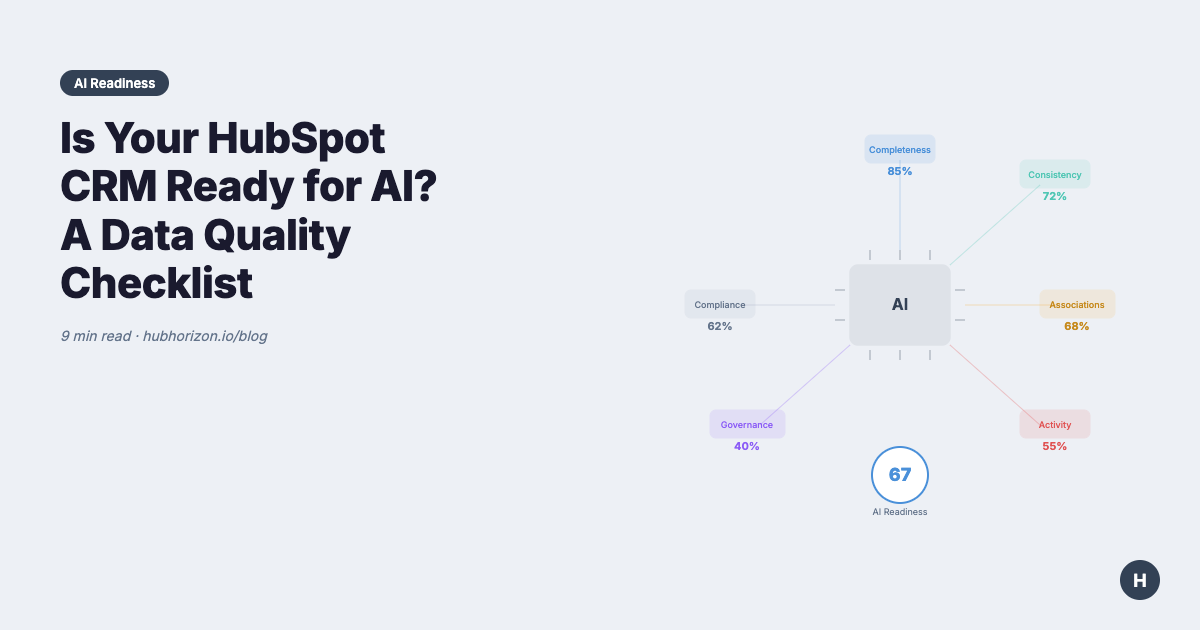
Assess your HubSpot CRM's AI readiness with a 6-pillar framework: completeness, consistency, associations, activity depth, governance, compliance.

Peter Sterkenburg
HubSpot Solutions Architect & Revenue Operations expert. 20+ years B2B SaaS experience. Founder of HubHorizon.
Predictive lead scoring, automated segmentation, AI-powered sales intelligence — these ship as standard features now. Every major CRM vendor offers them. But here's the catch: AI is only as good as the data you feed it.
Your HubSpot CRM might house thousands of contacts, hundreds of deals, and years of customer interactions. But is that data actually ready to power machine learning models? Or is it a collection of incomplete records, inconsistent formats, and orphaned associations that will produce garbage predictions?
Here's a six-pillar framework for assessing HubSpot AI readiness, with a scoring system and practical steps to close the gaps. These pillars are adapted from the formal data quality dimensions used in data management — accuracy, completeness, consistency, validity, uniqueness, and timeliness.
Why AI readiness matters now
The AI tools integrated into HubSpot—and third-party platforms connecting to your CRM—require structured, clean, complete data to function effectively. When you enable AI-powered features like:
- Predictive lead scoring (which contacts are most likely to convert)
- Content recommendations (what messaging resonates with which segments)
- Churn prediction (which customers are at risk)
- Automated deal forecasting (pipeline health and close probability)
...these systems train on your historical data. If your contact records are missing job titles, your deal associations are broken, or your lifecycle stages are inconsistently applied, the AI will learn the wrong patterns. You'll get confident-looking predictions based on flawed data.
The cost isn't just bad recommendations. It's wasted sales time chasing low-intent leads, missed revenue from ignored high-value prospects, and eroded trust in your data infrastructure. These same data quality issues drag down your overall CRM health score — and a low health score means AI tools have even less to work with.
The 6 pillars of HubSpot AI readiness
Six dimensions determine whether your CRM can reliably power AI applications. Each addresses a specific failure mode that breaks machine learning models.
1. Data completeness: Are your records actionable?
What it measures: The completeness dimension of data quality — the percentage of critical fields that are populated across your Contact, Company, Deal, and Ticket records.
AI models can't infer missing information. If 60% of your Contacts lack a lifecyclestage, the model can't learn what behaviors correlate with stage progression. If half your Companies have no industry value, segmentation models will fail. A data quality audit reveals exactly where these gaps are.
Scoring criteria:
- Excellent (90-100%): All core identity fields (name, email), demographic fields (job title, company, industry), and lifecycle/stage fields are consistently populated. Less than 5% missing data across critical properties.
- Good (75-89%): Most critical fields present, but gaps exist in secondary fields like phone numbers, location data, or persona tags.
- Fair (50-74%): Significant gaps in demographic or behavioral fields. Many records lack enough context for meaningful segmentation.
- Poor (<50%): Sparse data across the board. Records are shells with minimal actionable information.
Quick wins:
- Audit your 10 most-used properties. Calculate fill rate for each (populated records / total records).
- Create required field rules in HubSpot forms to stop new incomplete records from entering.
- Use workflows to flag Contacts missing critical fields, then enrich via manual research or data providers (Clearbit, ZoomInfo).
- For Companies, enable HubSpot's automatic enrichment features to backfill industry, size, and location data.
2. Data consistency: Can AI trust your values?
What it measures: Two related data quality dimensions — consistency (the same concept represented the same way across records) and validity (data conforming to defined formats and rules). In practice, these overlap: "VP Sales" vs "Vice President of Sales" is a consistency problem, while storing phone numbers without country codes is a validity problem. Both break AI models.
Machine learning models treat "VP Sales", "VP of Sales", "Vice President of Sales", and "vp-sales" as four different job titles. If your team has been free-typing into fields for years, you'll have hundreds of unique values representing a handful of actual roles.
Similarly, if a contact's lifecyclestage is "Customer" but they have no associated closed-won deal, that's a consistency violation. The AI can't learn reliable patterns when your data contradicts itself. This kind of cross-object contradiction is one of the five patterns that break your unified customer view.
Scoring criteria:
- Excellent (90-100%): Standardized field formats (phone numbers in E.164, dates in ISO 8601). Controlled vocabularies for categorical fields (dropdowns, not free text). Cross-field consistency validated (e.g., deal stages match pipeline definitions).
- Good (75-89%): Mostly standardized, with occasional formatting variations. Some free-text fields could be dropdowns.
- Fair (50-74%): Significant format drift. Manual cleanup needed quarterly to maintain usability.
- Poor (<50%): Wild west of formatting. Same concept represented dozens of ways. Frequent logical contradictions between fields.
Quick wins:
- Identify your top 5 categorical fields (industry, job title, lead source, etc.). Analyze unique value counts. If you have 200+ unique job titles, consolidate them.
- Convert free-text fields to dropdowns wherever possible. Use HubSpot's property settings to restrict input values.
- Implement validation workflows: "If lifecycle stage = Customer AND associated Deals = 0, send alert to ops team."
- Run regular deduplication: use HubSpot's native deduplication tools or third-party apps like Insycle to merge duplicates before they pollute training data.
3. Association integrity: Are your relationships accurate?
What it measures: Whether the links between objects (Contact-to-Company, Contact-to-Deal, Company-to-Deal, etc.) are complete, accurate, and reciprocal.
AI models often need to understand context across objects. A lead scoring model doesn't just look at contact behavior—it factors in the associated company's size, industry, and engagement history. If those associations are missing or broken, the model sees an incomplete picture.
Common association failures:
- Contacts with recent Deal activity but no Deal association (orphaned activity)
- Deals without associated Contacts (who's the stakeholder?)
- Companies with active Deals but no Contacts (ghost accounts)
- Contacts associated with multiple Companies when they should have one primary relationship
Scoring criteria:
- Excellent (90-100%): 95%+ of Deals have at least one associated Contact. 95%+ of Contacts have a Company association. No orphaned engagement data.
- Good (75-89%): Occasional gaps, but core associations (deal-to-contact) are reliable.
- Fair (50-74%): Frequent missing associations. Manual cleanup required before reporting is trustworthy.
- Poor (<50%): Associations are more exception than rule. Objects exist in isolation.
Quick wins:
- Run an association audit report: "Deals created in last 90 days WITH zero associated Contacts." Investigate and fix.
- Create a workflow: "When deal is created, if no contact is associated, alert deal owner immediately."
- Use HubSpot's automatic company association feature (associates Contacts to Companies based on email domain).
- For historical data, use HubSpot's association API or a tool like Insycle to bulk-associate records based on rules (e.g., "associate all Contacts with @acme.com to Acme Corp Company record").
4. Activity depth: Is there enough behavioral data?
What it measures: The volume and variety of engagement signals captured in your CRM—emails, meetings, calls, page views, form submissions, content downloads.
AI models that predict conversions or churn rely heavily on behavioral patterns. A contact who opens every email, attended two webinars, and booked a demo is qualitatively different from one with zero recorded activity. But if your CRM isn't capturing those signals, the AI can't learn the difference.
Scoring criteria:
- Excellent (90-100%): Rich activity data across multiple channels. Email engagement tracked via HubSpot or synced from your email tool. Meeting data synced from calendar. Website behavior tracked via HubSpot tracking code. Call logs captured via dialer integration.
- Good (75-89%): Core activities tracked (email, forms, meetings), but gaps exist (e.g., no call logging, inconsistent page view data).
- Fair (50-74%): Basic form submissions captured, but limited insight into ongoing engagement.
- Poor (<50%): Sparse activity data. CRM is a glorified contact database with no behavioral context.
Quick wins:
- Install HubSpot's tracking code on your website if not already present. This captures page views, session duration, and content engagement automatically.
- Integrate your calendar (Google Calendar, Outlook) so meetings auto-log to contact timelines.
- If your sales team uses a dialer (RingCentral, Aircall, etc.), ensure call logs sync to HubSpot.
- Set up key behavioral events as custom events (e.g., "Watched demo video", "Downloaded pricing PDF") so they feed into scoring models.
- Audit engagement data: "Contacts created in last 180 days WITH zero activities." These are data ghosts—investigate why engagement isn't being captured.
5. Governance maturity: Is data management a process or an afterthought?
What it measures: Whether your organization has systematic processes to maintain data quality over time—not just one-time cleanup efforts, but ongoing standards, ownership, and enforcement.
AI readiness isn't a one-time achievement. Data decays. New team members introduce inconsistencies. Integrations break. Without governance, your CRM will drift back into chaos within months.
Scoring criteria:
- Excellent (90-100%): Documented data standards (style guide for how to format fields). Named data steward responsible for quality. Regular audits (monthly or quarterly). Training for new CRM users. Validation rules and workflows prevent bad data from entering.
- Good (75-89%): Some standards documented. Periodic cleanup efforts. Ad hoc training.
- Fair (50-74%): Reactive cleanup when reports break. No formal ownership or standards.
- Poor (<50%): No governance. Data quality is whoever's responsibility (so no one's responsibility).
Quick wins:
- Appoint a data steward—someone (RevOps, Marketing Ops, Sales Ops) who owns data quality as a KPI.
- Document your top 10 field standards in a shared wiki (e.g., "Job Title: use title case, no abbreviations, no emojis").
- Schedule a quarterly data health review: run key metrics (fill rates, consistency scores, association gaps) and present to leadership.
- Create a CRM onboarding checklist for new hires that includes data hygiene training.
- Use HubSpot workflows to auto-fix common issues (e.g., "If phone number is entered without country code, prepend +1").
6. Compliance posture: Are you AI-ready and legally sound?
What it measures: Whether your data handling practices comply with privacy regulations (GDPR, CCPA) and whether you have consent and retention policies that support responsible AI use.
AI models trained on your CRM data inherit your compliance obligations. If you're feeding PII (personally identifiable information) into a model without proper consent or data minimization, you're creating legal risk. If you retain data longer than necessary, you're violating retention policies and exposing yourself to breaches.
Scoring criteria:
- Excellent (90-100%): Explicit consent captured for AI processing where required. PII handling documented. Data retention policies enforced (auto-delete old records). Regular compliance audits. Sensitive data (health info, financial data) properly segregated or excluded from AI training sets.
- Good (75-89%): Basic GDPR/CCPA compliance. Retention policies exist but enforcement is manual.
- Fair (50-74%): Compliance is aspirational. Policies written but not consistently enforced.
- Poor (<50%): No compliance processes. Flying blind on consent, retention, and PII handling.
Quick wins:
- Audit your HubSpot properties for sensitive data (SSN, credit card info, health data). These should NEVER be in your CRM, or if required for specific workflows, must be encrypted and access-restricted.
- Create a GDPR/CCPA compliance checklist: Do contacts have the right to be forgotten? Can they export their data? Is consent recorded?
- Set up HubSpot data retention workflows: "If contact hasn't been active in 36 months AND is not a customer, delete record."
- Document your AI usage policy: "We use CRM data to train lead scoring models. Contacts can opt out by emailing privacy@yourcompany.com."
- Use HubSpot's cookie consent banner to capture tracking consent (required in EU).
Where the other dimensions fit
The six pillars above are adapted from the formal data quality dimensions framework. Two dimensions — uniqueness (duplicate records) and timeliness (data recency) — aren't broken out as separate pillars here because they're addressed within the other categories. Duplicates undermine every pillar — fragmented activity history, inconsistent associations, artificially inflated completeness numbers. Stale data affects activity depth and completeness metrics. If you want to measure all six dimensions independently, our data quality dimensions guide covers the full framework.
The AI readiness scoring framework
Each of the six pillars can be scored 0-100. Your overall AI readiness score is the weighted average:
- Data Completeness: 20%
- Data Consistency: 20%
- Association Integrity: 15%
- Activity Depth: 15%
- Governance Maturity: 15%
- Compliance Posture: 15%
Interpreting your score:
- 80-100 (AI-Ready): Your CRM is production-ready for AI applications. You can confidently deploy predictive models, automated segmentation, and intelligent workflows.
- 60-79 (Needs Improvement): Your data can support basic AI features, but accuracy will suffer. Prioritize the lowest-scoring pillars before investing heavily in AI tools.
- 40-59 (Not Ready): Significant data quality issues will cause AI models to fail or produce unreliable results. Focus on foundational cleanup before enabling AI features.
- 0-39 (Critical Issues): Your CRM is not suitable for AI use. Predictions will be meaningless. Invest in data hygiene infrastructure before considering AI.
How HubHorizon measures AI readiness
Manually auditing these six pillars across thousands of records is impractical. HubHorizon automates this assessment — it connects to your portal and calculates your AI readiness score automatically.
HubHorizon connects securely to your HubSpot portal and analyzes:
- Fill rates across 50+ standard and custom properties
- Value consistency (identifies format drift and duplicate meanings)
- Association completeness (flags orphaned records and broken relationships)
- Activity volume and recency across Contacts, Companies, and Deals
- Property usage patterns (identifies unused fields and over-customization)
- Compliance signals (detects sensitive data patterns, consent field usage)
Within minutes, you receive:
- An overall AI readiness score (0-100)
- Per-pillar scores with specific issues flagged
- A prioritized remediation plan (which issues to fix first for maximum impact)
- Exportable audit reports for your RevOps or data team
The tool quantifies exactly how messy your data is, where the problems are, and what the business impact is.
Getting started: Your 30-day AI readiness plan
Week 1: Baseline Assessment
- Run a HubHorizon analysis to establish your current AI readiness score
- Identify your lowest-scoring pillar
- Export the detailed issue list for that pillar
Week 2: Quick Wins
- Fix the top 10 most impactful issues (HubHorizon prioritizes by severity)
- Common week-2 fixes: bulk-associate orphaned Deals to Contacts, standardize the top 5 free-text fields, enable required fields on forms
Week 3: Process Changes
- Document data standards for your team
- Set up validation workflows to prevent new bad data
- Assign data stewardship responsibility
Week 4: Re-Assessment
- Run HubHorizon again to measure improvement
- Set quarterly data health review calendar reminders
- Present AI readiness score to leadership as a KPI
Most teams see a 15-25 point improvement in their AI readiness score within 30 days by focusing on high-leverage fixes.
The bottom line: AI won't fix bad data
I keep hearing the same assumption: AI will figure it out. Give it messy data and the model will sort through the noise. That's not how it works. AI amplifies whatever you feed it — clean data produces useful output, messy data produces confident nonsense.
If your HubSpot CRM is 60% complete with inconsistent formatting and broken associations, an AI lead scoring model will produce 60%-accurate predictions with inconsistent logic and broken insights. Garbage in, garbage out.
But if you invest in the six pillars of AI readiness — completeness, consistency, associations, activity, governance, compliance — you get AI tools that actually work:
- Lead scoring that actually predicts conversions
- Segmentation that resonates because it's based on real behavioral patterns
- Forecasting you can trust because it's trained on clean pipeline data
- Churn prediction that identifies at-risk customers before it's too late
You're going to prepare your CRM for AI at some point. The only choice is whether you do it now, with a structured assessment and remediation plan, or later — after your first AI project fails because the data wasn't ready.
Frequently Asked Questions
Is my CRM ready for AI?
Your CRM is AI-ready when it scores well across six pillars: data completeness (>80% fill rates on key fields), format consistency, association health, activity depth, data governance maturity, and compliance readiness. Most HubSpot portals score 40-60% — well below the threshold needed for reliable AI predictions. Run a health check to see your actual scores.
What AI readiness score do I need for HubSpot Breeze?
For Breeze AI to produce useful outputs, your portal should score at least 60% across all six pillars. Below 60%, Breeze Intelligence will return generic enrichment, Copilot will draft vague emails, and Agents will make poor targeting decisions. For a Breeze-specific assessment, see our Breeze AI data readiness checklist.
How long does it take to make a CRM AI-ready?
It depends on your starting point. A portal scoring 50-60% can reach 70%+ in 4-8 weeks with focused effort on data completeness and association health — the two pillars with the highest impact. A portal below 40% typically needs 3-6 months of structured remediation, including governance changes. The key is to fix completeness first, since every other pillar depends on having populated fields.
What data does AI need from a CRM?
AI tools need three categories of CRM data: structured fields (properly formatted, consistently populated properties), relationship data (associations between contacts, companies, deals, and activities), and behavioural signals (emails, calls, meetings, page views). Most CRMs have the structured fields partially covered but are weak on associations and activity logging — which are exactly the signals AI uses to make predictions.
Check your AI readiness score free
Ready to see how your HubSpot CRM scores on the six pillars of AI readiness?
Run a free HubHorizon analysis →
No credit card required. You'll receive your complete AI readiness report in under 5 minutes, including:
- Overall AI readiness score (0-100)
- Per-pillar breakdown with specific issues flagged
- Prioritized remediation roadmap
- Exportable audit report for your team
Your CRM data is your competitive advantage — but only if it's AI-ready. Find out where you stand today. Check our pricing plans for full AI readiness scoring with per-pillar breakdowns and remediation roadmaps.
Peter Sterkenburg is the founder of HubHorizon, a HubSpot portal health and optimisation platform. He's spent years in scale-up RevOps — building the systems, fighting the fires, and eventually building the tool he wished he'd had.
Related articles
The HubSpot Pipeline Management Cheat Sheet: Views, Signals, and Reviews in One Place
One-page HubSpot pipeline reference: 6 deal health signals, warning thresholds, 9 saved view recipes, stage design checklist, and review prep guide.
Read articleYour HubSpot Pipeline Is a Data Structure. Most Are Broken.
Your deal pipeline is a data structure. When stages, exit criteria, and required properties break, forecasting and AI produce garbage. Diagnose and fix it.
Read articleWhy Your HubSpot Sales Forecast Is Wrong — and It's Not a Process Problem
Most forecasting failures are data failures, not process failures. Diagnose and fix the data foundation your HubSpot forecast depends on.
Read article