

Your HubSpot Portal Is Not a Source of Truth. It's a Lens.
HubSpot isn't your source of truth — it's a lens. Orphan records, broken associations, and contradictions fracture it. Here's how to fix the view.

Peter Sterkenburg
HubSpot Solutions Architect & Revenue Operations expert. 20+ years B2B SaaS experience. Founder of HubHorizon.
Last quarter I sat in a quarterly business review where four departments presented four different customer counts. Marketing reported 12,400 contacts in their nurture segments. Sales had 8,100 qualified accounts. Customer Success was managing 3,200 active customers. Finance showed 2,900 paying accounts on the books.
All four teams pulled their numbers from HubSpot. All four were confident. None of the numbers agreed.
The CEO's question was reasonable: "We have one CRM. How do we have four different answers?"
The real answer is uncomfortable. It wasn't a reporting problem. Nobody had the wrong filters. The data itself told four different stories because the underlying records were fractured. Contacts existed without companies. Deals sat disconnected from the people who signed them. Lifecycle stages contradicted deal statuses. The same customer appeared in multiple places under slightly different names.
HubSpot contained all the data. It just didn't contain a coherent picture.
The "source of truth" problem
Somewhere along the way, "source of truth" became the default way to describe a CRM. I hear it in every discovery call, see it in every vendor pitch. "HubSpot is your single source of truth."
The phrase sounds right. It's also wrong, and the error isn't semantic. It changes how teams think about data quality.
"Source of truth" implies that HubSpot is where truth originates. It's not. Your customer data comes from everywhere:
- Billing platforms record who pays what and when
- Product analytics track who uses what and how often
- Marketing tools capture form fills, email engagement, ad clicks
- Support systems log tickets, conversations, resolution times
- Enrichment providers add firmographic and technographic data
- Sales reps enter notes, update stages, log calls
HubSpot doesn't create this data. It receives it. Through integrations, imports, manual entry, and API syncs, data flows into HubSpot from dozens of upstream systems. The CRM is where these streams converge into something your revenue teams can see and act on.
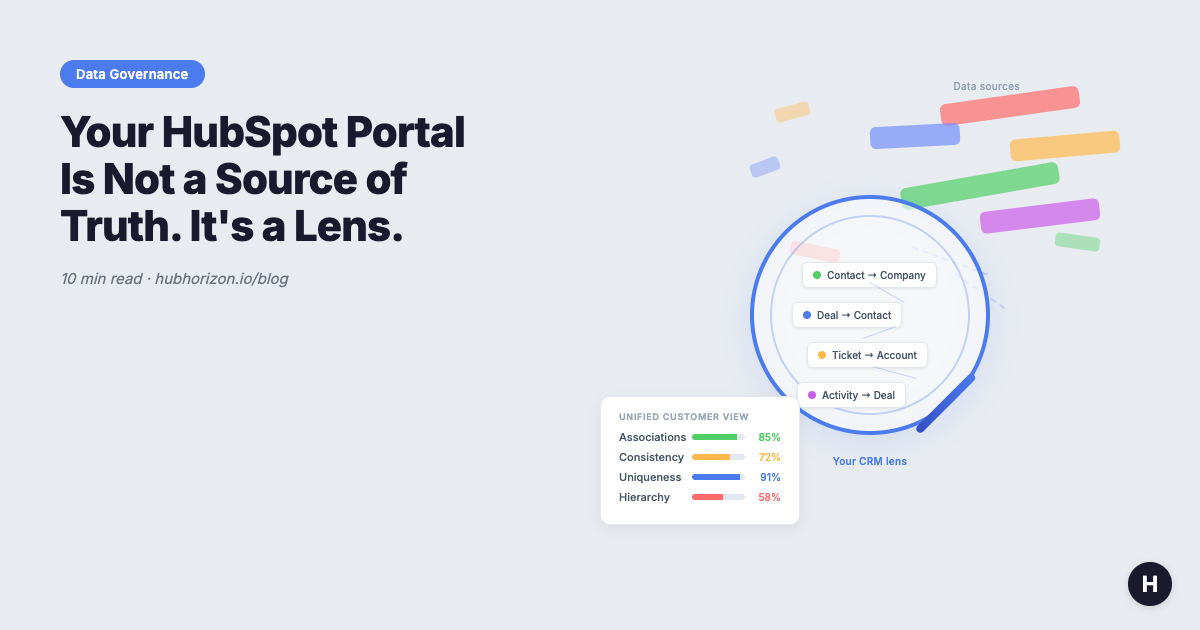
That makes HubSpot a lens, not a source. It's the place where your organisation looks to see the full customer relationship. Every dashboard, every report, every automation, every AI tool reads from that lens.
The distinction matters because it shifts what you optimise for. If HubSpot is the "source of truth," the problem is bad data entry. Train people to type better. If HubSpot is a lens, the problem is governance: how data flows in, how conflicts get resolved, how records stay connected, and how the picture stays coherent as the business changes around it.
The six data quality dimensions (accuracy, completeness, consistency, validity, uniqueness, timeliness) are the properties of a clean lens. When any of them degrades, the view distorts.
Five ways the lens breaks
I've analysed hundreds of HubSpot portals over the past few years. The specific data problems vary, but the structural patterns repeat. Five types of fractures account for most of the damage.
1. Orphan records
An orphan record is a contact without a company, a deal without a contact, or a ticket without anyone attached. The record exists in HubSpot. It has data in its fields. But it's disconnected from the relationship graph that gives it meaning.
Orphans enter the system through three main doors: bulk imports that skip association mapping, integrations that create records in one object but not another, and manual creation by team members who don't link records after the fact. The third one is the most common. Someone creates a deal, fills in the details, and forgets to associate the contact or company. The deal looks complete until someone tries to report on it.
The cost is quiet but real. Orphan contacts inflate your database size without contributing to segmentation or scoring. Orphan deals break pipeline reporting because they can't be attributed to accounts. AI tools trained on orphaned data learn the wrong patterns. Your CRM health score drops because association quality, one of its core components, measures exactly this.
In the portals I audit, orphan rates of 15-30% on contacts are common. That means up to a third of your contact database is functionally invisible to any analysis that relies on the relationship between objects.
2. Broken associations
This one is subtler than orphans. The records are linked. Associations exist. But the relationship graph has gaps that make the picture incomplete.
A company record has 50 contacts, but only 2 are associated with its deals. Activity history is spread across contacts who should be connected to the same opportunity but aren't. A support ticket is linked to a contact but not to the company or the deal that created the customer relationship. The association exists, but it tells an incomplete story.
How it happens: sales reps create a deal and associate the primary contact, the person they're talking to, but skip the other stakeholders. Integrations connect to primary contact only. Association labels, which HubSpot provides to distinguish between roles like "decision maker" and "end user," go unused because nobody set them up.
The damage shows up in forecasting and account-based reporting. A deal that looks like a single-threaded opportunity (one contact, one company) might actually involve five people across two business units. Without the associations, the account team can't see the full picture, and neither can any tool that reads from the CRM.
3. Cross-object contradictions
This is the pattern that caused the four-different-numbers problem in my opening example. The same fact is represented differently across objects, and the contradictions accumulate silently.
A contact's lifecycle stage says "Customer," but the contact has no closed-won deal. A company's industry is "Technology," but 80% of its contacts work in healthcare. A deal closed six months ago, but the associated company's last activity date hasn't updated since the previous year. A contact is marked as "unsubscribed" but the company they belong to is in an active nurture workflow.
Each contradiction is individually small and easy to explain. "Oh, someone updated the lifecycle stage manually." "That industry was set at import and never corrected." But collectively, they erode trust in the data. Report consumers learn to second-guess the numbers. Sales reps stop updating fields because the data is already wrong. A feedback loop forms: bad data reduces trust, reduced trust reduces data entry discipline, less discipline makes the data worse.
Consistency, as a formal data quality dimension, is one of the hardest to maintain because it requires agreement between records that were often created by different people, at different times, through different channels.
4. Duplicate records
Duplicates are the most visible data quality problem and usually the first one teams attempt to fix. But deduplication in B2B is harder than it looks.
Matching on email address catches the easy cases. It misses the company that appears as "Acme Inc." in one record, "Acme Corporation" in another, and "ACME" in a third, each with a different domain. It misses the contact who submitted a form with their personal Gmail and was later added by a sales rep under their work email. It misses the acquired company that still has its own records alongside the parent company's.
The real cost isn't having two records for the same person. It's that activity history fragments. One record shows the marketing engagement. The other shows the sales conversations. Neither shows the complete picture. Pipeline gets inflated because the same deal appears under two companies. Outreach sequences fire twice. Reporting overcounts.
Duplicate rates above 3% signal a process problem that goes beyond one-time cleanup. Property hygiene amplifies the issue: when duplicate properties exist alongside duplicate records, the same data point might live in four places (two records, each with two versions of the same field).
5. Flat account structures
Most HubSpot portals treat companies as flat entities. Every company record sits at the same level, whether it's a solo startup or a multinational with thirty subsidiaries.
HubSpot's parent-child company associations have existed for years. Most portals never configure them. The result is that a parent company and its subsidiaries appear as unrelated records. Revenue can't be aggregated across the relationship. An enterprise deal that spans three business units looks like three unrelated small deals. Account managers can't see the total relationship value.
This matters more as companies grow into mid-market and enterprise sales motions. A flat account model is adequate when every customer is a single entity. Once you start selling to organisations with divisions, regional offices, or acquired brands, the lack of hierarchy fragments your view of the account.
Missing hierarchy also breaks ABM (account-based marketing) targeting. If your ABM platform sees six company records instead of one account group, it treats them as six separate targets. Budget gets scattered across what should be a coordinated effort.
What a coherent view looks like
When these five patterns are addressed, the change isn't dramatic. There is no transformation. Things just start working the way they should have been working all along.
Every department pulls the same customer count because the underlying records are connected and consistent. AI tools produce useful output because they're training on clean, associated, deduplicated data. Your CRM health score reflects the actual state of your data rather than masking problems behind an aggregate number. Sales reps trust the data enough to keep it updated, which creates the positive feedback loop that maintains quality over time.
This isn't a technology problem. You don't need a new platform, a customer data platform, or a master data management system. HubSpot already has the structural capability. What's missing is governance.
Governance, not technology
The fix for a dirty lens isn't a new lens. It's cleaning the one you have. Here's where to start.
Run a baseline audit. You can't fix what you can't measure. Assess your current state across all five patterns: orphan rates, association coverage, cross-object consistency, duplicate rates, and hierarchy completeness. Our data quality audit guide walks through the process in detail.
Give data quality an owner. When data quality is everyone's responsibility, nobody is responsible. One person (or at minimum, one role) needs to own the lens. They set the standards, monitor the metrics, and have the authority to enforce import rules and association requirements.
Define your association contract. Which objects must be linked for a record to count as "complete"? At a minimum: every contact needs a company, every deal needs at least one contact and one company, every ticket needs a contact. Write it down. Make it a policy, not a suggestion.
Fix imports at the source. Every bulk import should include association mapping. No orphans by default. If an import file doesn't include company associations for contacts, it goes back to the person who created it. This is where the addition bias is most dangerous: importing 5,000 records without associations is fast. Cleaning up the orphans after the fact takes ten times longer.
Schedule recurring maintenance. Quarterly at minimum. After every major import, integration change, or team change. Data quality isn't a project with a completion date. It's a practice, like maintaining any other operational system. The RevOps technical debt framework helps explain to leadership why this recurring investment is necessary: shortcuts compound, and the interest payments eventually exceed the cost of regular maintenance.
Frequently Asked Questions
What is a unified customer view in HubSpot?
A unified customer view in HubSpot is a coherent, connected picture of each customer relationship assembled from data flowing in from billing platforms, product analytics, marketing tools, support systems, and direct sales activity. It is not a feature you enable — it is a condition of your data. When contacts are properly linked to companies, deals are associated with the right people, lifecycle stages are consistent, and duplicate records are resolved, every team looking at the same account sees the same picture. When those connections break down, each team sees a different version of reality.
Why is HubSpot not a source of truth?
HubSpot does not generate your customer data — it receives it. Stripe records who pays, your product tracks who uses what, marketing platforms capture engagement, and support tools log conversations. HubSpot is the lens where those streams converge, not the origin of any of them. Calling it a "source of truth" mislocates the problem: if the data is wrong, the fix is not better data entry into HubSpot — it is governing how data flows in, how conflicts are resolved, and how records stay connected as the business changes. The six formal data quality dimensions describe the properties of a clean lens.
How do orphan records affect HubSpot data quality?
Orphan records — contacts without companies, deals without contacts, tickets without anyone attached — inflate your database without contributing to any analysis that depends on object relationships. In practice, they break pipeline reporting (orphan deals cannot be attributed to accounts), distort segmentation (orphan contacts count toward database size but are invisible to audience filters), and feed AI tools incorrect training signals. Portals with orphan rates of 15–30% on contacts effectively have a third of their contact database invisible to any relationship-aware analysis. The CRM health score measures association quality as a core component precisely because orphan rates are one of the strongest indicators of data foundation health.
How do you fix broken associations in HubSpot?
Start by auditing association coverage across your core objects: what percentage of deals have at least one contact, what percentage of contacts have a company, and what percentage of tickets are linked to both. Define a minimum association contract — the set of links that must exist for a record to be considered complete — and enforce it on all future imports and integrations. For existing gaps, use HubSpot's association tools or a data operations tool to batch-link records based on matching fields like email domain or deal company name. A full walkthrough of the audit process is in the data quality audit guide.
The lens is already there
Most companies don't need a new tool to see their customers clearly. They need to take better care of the tool they already have.
HubSpot is the lens your revenue teams look through every day. When it's clean and coherent, the entire organisation sees the same customer. When it's fractured, every team sees their own version and nobody trusts anyone else's numbers.
The five patterns above are where fractures form. They're also where they can be repaired. Tools like HubHorizon can automate the assessment, diagnosing all five patterns and scoring your portal against each one in under an hour. But automated or manual, the work is the same: audit, govern, maintain.
Your CRM already has everything it needs to give you a unified customer view. The question is whether you're treating it that way.
Start your free portal health check at hubhorizon.io — connect your portal in 30 seconds and see your unified customer view scored across all five dimensions. View pricing plans for continuous monitoring and trend tracking.
Peter Sterkenburg is the founder of HubHorizon, a HubSpot portal health and optimisation platform. He's spent years in scale-up RevOps — building the systems, fighting the fires, and eventually building the tool he wished he'd had.
Related articles
The HubSpot Pipeline Management Cheat Sheet: Views, Signals, and Reviews in One Place
One-page HubSpot pipeline reference: 6 deal health signals, warning thresholds, 9 saved view recipes, stage design checklist, and review prep guide.
Read articleYour HubSpot Pipeline Is a Data Structure. Most Are Broken.
Your deal pipeline is a data structure. When stages, exit criteria, and required properties break, forecasting and AI produce garbage. Diagnose and fix it.
Read articleWhy Your HubSpot Sales Forecast Is Wrong — and It's Not a Process Problem
Most forecasting failures are data failures, not process failures. Diagnose and fix the data foundation your HubSpot forecast depends on.
Read article