

The Business Case for CRM Data Cleanup (With ROI Formula)
How to calculate the ROI of CRM data cleanup: cost of bad data formula, the 1-10-100 rule, worked examples, and how to present the business case to leadership.

Peter Sterkenburg
HubSpot Solutions Architect & Revenue Operations expert. 20+ years B2B SaaS experience. Founder of HubHorizon.
A VP of Sales at a 150-person B2B company told me his team was losing deals but couldn't explain why. Win rates had dropped 8 points over two quarters. The pipeline looked healthy. The product hadn't changed. Nobody could point to a single cause.
I ran an analysis on their HubSpot portal. Thirty-one percent of contacts had no company association. The industry field contained 94 unique values for what should have been 15 industries. A quarter of deals had close dates in the past that nobody had updated. Copilot was generating email drafts addressed to job titles people hadn't held in two years.
The VP asked what it would take to fix this. I said about $15,000 in staff time plus a monitoring tool. He said he'd need to build a business case for the CFO.
So we built one. Not by arguing that clean data is good (everyone already knows that). By calculating what bad data was already costing them. The number was $380,000 per year. The CFO approved the project in one meeting.
That's the business case pattern that works: don't ask for permission to spend money on cleanup. Show the money you're already losing.
What bad data actually costs
Gartner estimates that poor data quality costs the average enterprise $12.9-15 million per year. That sounds like an enterprise problem, but the cost scales down proportionally. A 100-person company with a 10-person sales team isn't losing $15 million, but they're losing enough to justify every data cleanup project they'll ever consider.
The costs fall into three categories, and you need all three to build a convincing case.
Lost revenue
Validity's 2025 State of CRM Data Management report (602 CRM users across the US, UK, and Australia) found that 37% of organisations reported losing revenue directly from poor data quality. A separate analysis by Forbes and IndustrySelect found that 44% of companies experience 10%+ annual revenue loss from CRM data decay.
Validity's most specific finding: companies lose an average of 16 sales deals per quarter from bad data. That number lets you calculate real revenue impact for any company:
Lost deals × average deal size × 4 quarters = annual revenue lost
For a company with a $15,000 average deal size, that's $960,000 per year. Even if you're sceptical of the average and halve it to 8 deals per quarter, that's still $480,000.
Wasted time
Time costs are the easiest to calculate and the hardest to argue against, because the numbers come from your own payroll.
Validity found that CRM users spend an average of 13 hours per week hunting for basic information. IndustrySelect's research puts the cost at $32,000 per sales rep per year and 550 hours per year per rep spent on data problems — cleaning records, verifying information, working around gaps. SMARTe's analysis found that inside sales reps waste 27.3% of their time pursuing bad leads from inaccurate data.
The formula:
Number of reps × 550 hours/year × hourly rate = annual time cost
For a team of 10 reps at $40/hour (roughly $80K/year salary), that's $220,000 in annual time wasted on data problems. These are hours your sales team spends not selling. Every hour spent verifying a phone number or searching for the right contact is an hour not spent on pipeline.
Hidden costs
The third category is harder to quantify but often the most persuasive for leadership, because it connects to strategic initiatives they already care about.
Data fabrication. Validity found that 37% of CRM users regularly fabricate data to tell leaders what they want to hear. When the CRM is unreliable, people stop trusting it and start entering whatever gets the form submitted. Your forecasting models, pipeline reports, and segment analyses are all built on this data. If a third of it is made up, your forecasts are fiction.
Campaign waste. When your industry field has 94 values instead of 15, your account-based marketing targets the wrong segments. When contact records are stale, your email campaigns bounce. When associations are broken, your account scoring misses buying signals. Every misdirected campaign is budget spent without return.
AI underperformance. If your team is investing in Breeze AI features, bad data makes them produce confidently wrong outputs. The AI readiness score measures this directly: portals scoring below 45 get unreliable results from every AI feature. That's not a tool problem. It's a data problem, and it means your AI investment is wasted until the data is fixed.
Compliance risk. Stale consent records, outdated contact preferences, contacts who should have been deleted under GDPR — these are governance gaps that carry real financial risk in regulated markets.
The 1-10-100 rule
George Labovitz and Yu Sang Chang introduced the 1-10-100 rule in 1992, and it's still the clearest way to frame data quality investment. The idea: every dollar you spend preventing bad data saves ten dollars in correction and a hundred dollars in failure costs.
Applied to a HubSpot portal:
| Cost level | What it looks like | Example cost |
|---|---|---|
| $1 — Prevention | Required fields on forms, validation workflows, property naming standards, controlled vocabularies | Minutes of configuration time |
| $10 — Correction | Dedup campaigns, import cleanup, property standardisation, enrichment runs | Hours of staff time per cleanup cycle |
| $100 — Failure | Lost deal from wrong data, compliance fine, AI sending wrong email, broken forecast | Thousands per incident |
The ratio isn't exact. It's a mental model. But it explains why governance is cheaper than cleanup, and cleanup is cheaper than doing nothing. When you present this to a CFO, the question shifts from "how much does cleanup cost?" to "how long have we been paying the $100 rate?"
The ROI formula
Here's the formula I use when building a business case for CRM data cleanup. It's not complicated. The hard part is gathering your own numbers, not the maths.
Step 1: Calculate the annual cost of bad data
| Cost component | How to estimate | Your number |
|---|---|---|
| Lost revenue | Deals lost/quarter × avg deal size × 4 | _________ |
| Wasted rep time | Reps × 550 hours × hourly rate | _________ |
| Campaign waste | Marketing budget × estimated misdirection % | _________ |
| AI underperformance | AI tool cost × % of unreliable outputs | _________ |
| Compliance risk | (Estimate or note as qualitative) | _________ |
| Total annual cost | _________ |
Step 2: Calculate the cleanup investment
| Investment | How to estimate | Your number |
|---|---|---|
| Audit + cleanup tool | Annual subscription (e.g., EUR 199-399/yr) | _________ |
| Staff time | Hours × hourly rate for initial cleanup | _________ |
| Ongoing monitoring | Hours/month × rate × 12 | _________ |
| Consulting (if any) | One-time engagement fee | _________ |
| Total investment | _________ |
Step 3: Calculate ROI
ROI = (annual cost of bad data - cleanup investment) / cleanup investment × 100
Worked example: Mid-market SaaS (10-person sales team)
| Component | Calculation | Amount |
|---|---|---|
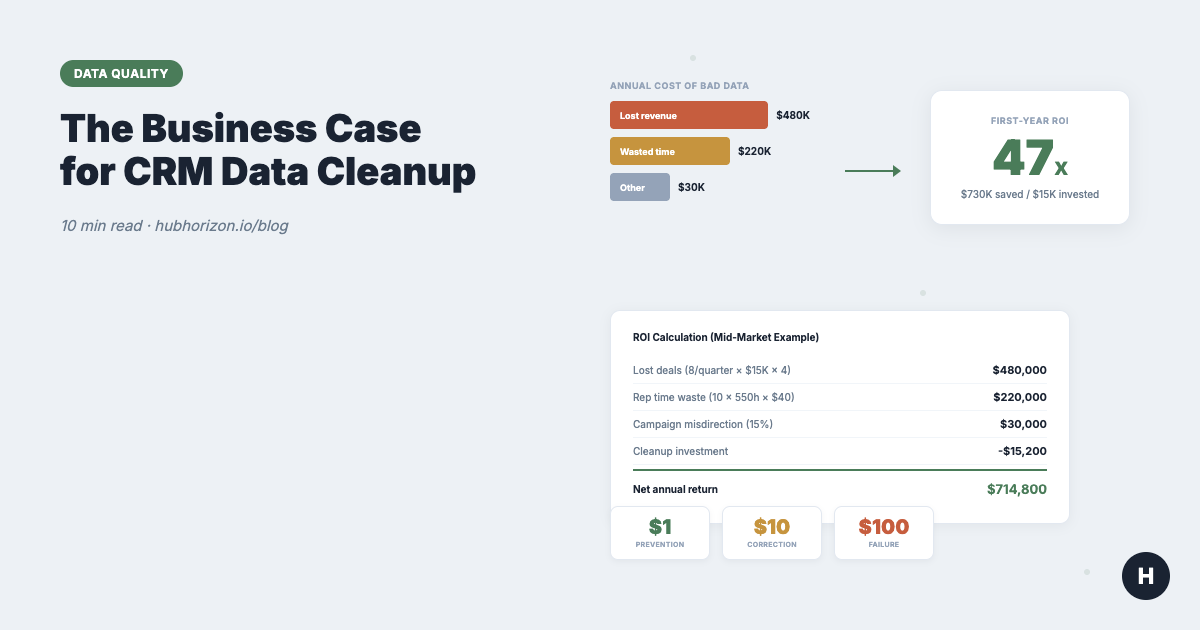
| Lost revenue | 8 deals/quarter × $15,000 × 4 | $480,000 |
| Wasted time | 10 reps × 550 hours × $40/hr | $220,000 |
| Campaign waste | $200,000 budget × 15% misdirected | $30,000 |
| AI underperformance | (Qualitative — not quantified) | — |
| Total annual cost | $730,000 |
| Investment | Detail | Amount |
|---|---|---|
| Monitoring tool | Continuous data quality platform | $2,400/yr |
| Initial cleanup | 200 hours × $40/hr (internal) | $8,000 |
| Ongoing maintenance | 10 hours/month × $40/hr × 12 | $4,800 |
| Total investment | $15,200 |
ROI = ($730,000 - $15,200) / $15,200 × 100 = 4,700%
Even if you're deeply sceptical of the revenue loss numbers and cut them by 75%, the time cost alone ($220,000) against a $15,200 investment gives you a 1,347% ROI.
The point isn't the exact percentage. It's that any reasonable calculation produces an ROI so large that the cleanup pays for itself many times over. The CFO question isn't "should we do this?" It's "why haven't we done this already?"
Conservative example: Small team (3 reps, tight budget)
| Component | Calculation | Amount |
|---|---|---|
| Lost revenue | 4 deals/quarter × $8,000 × 4 | $128,000 |
| Wasted time | 3 reps × 550 hours × $35/hr | $57,750 |
| Total annual cost | $185,750 |
| Investment | Detail | Amount |
|---|---|---|
| Monitoring tool | Free tier or basic plan | $200/yr |
| Staff time | 40 hours initial + 5 hrs/month ongoing | $3,500 |
| Total investment | $3,700 |
ROI = ($185,750 - $3,700) / $3,700 × 100 = 4,921%
Data decay means cleanup isn't one-time
Even if the ROI is obvious, some leaders will treat data cleanup as a one-time project: fix it once, move on. The data decay research explains why that doesn't work.
B2B contact data decays at 22.5-70.3% annually depending on industry and data type. IndustrySelect found that 70.8% of business contacts experience at least one change (job title, phone, email, address) within 12 months. CRM databases expand roughly 40% per year, with about 20% of new data entering inaccurate or outdated from day one.
Run these numbers forward. A portal with 50,000 contacts today will have 70,000 in a year. Of the original 50,000, roughly 35,000 will have at least one stale field. Of the 20,000 new records, 4,000 entered with problems. That's 39,000 records needing attention out of 70,000. Over half. In one year.
This is why one-time cleanup projects fail. You spend three weeks fixing everything, and six months later the portal is back where it started. The data governance policy article covers how to build the ongoing process. Continuous monitoring with automated audit tools catches decay as it happens instead of letting it compound for months.
The business case for cleanup is also the business case for monitoring. The ROI calculation above should include ongoing maintenance costs, because the alternative is paying for a full cleanup again every 12-18 months.
How to present this to leadership
I've helped build about a dozen of these business cases. The pattern that works:
Lead with the cost of doing nothing. Don't open with "here's what cleanup costs." Open with "here's what bad data is costing us right now." The first framing asks for permission to spend money. The second reveals money that's already being wasted.
Use their own numbers. Pull your actual average deal size from HubSpot. Count your actual sales reps. Use your actual salary data. A generic "bad data costs $15 million per year" doesn't land with a CFO. "Our 10 reps waste $220,000 per year searching for information" does, because those are their numbers.
Show the 1-10-100 progression. Walk through a specific example from your portal. "We're currently paying $100 per incident for data failures. With prevention controls, we'd pay $1 per record." That reframes cleanup from an expense to a cost reduction.
Tie to initiatives they already care about. If leadership is investing in AI tools (Breeze, third-party scoring, chatbots), connect data quality to AI performance. If they care about forecast accuracy, show how data fabrication (37% of users, per Validity) undermines every forecast. If they're focused on sales productivity, show the 550 hours per rep per year figure. Attach the business case to something that already has budget and attention.
Frame it as technical debt. Engineering teams understand that accumulated shortcuts eventually slow everything down. CRM data quality is the same concept in a RevOps context. Every month without governance adds interest on the data debt, and eventually the interest payments (time wasted, deals lost, AI underperforming) exceed the cost of paying it down.
Start with a data quality audit to get your baseline numbers. You can't calculate the cost of bad data without knowing how bad your data actually is. The audit gives you the fill rates, duplicate counts, and association gaps that feed directly into the ROI formula. Your data quality score and data quality dimensions provide the framework for measuring improvement over time.
Frequently Asked Questions
How much does bad CRM data cost?
Research puts the cost at multiple levels. Gartner estimates $12.9-15 million per year for the average enterprise. At the team level, IndustrySelect found that bad data costs roughly $32,000 per sales rep per year in wasted time (550 hours annually). Validity's 2025 survey found that 37% of organisations lose revenue directly from data quality issues, with companies losing an average of 16 sales deals per quarter from bad data.
What's the ROI of CRM data cleanup?
The formula is: (annual cost of bad data - cleanup investment) / cleanup investment × 100. For a mid-market team of 10 reps, the annual cost of bad data typically exceeds $500,000 (time waste plus lost deals). A cleanup investment of $15,000-30,000 produces ROI well above 1,000%. Even conservative calculations that exclude revenue loss and count only time savings produce 3-5x returns.
How often should you clean CRM data?
One-time cleanups lose their value within 6-12 months due to data decay. B2B contact data decays at 22.5-70.3% annually, and 70.8% of business contacts experience at least one change within 12 months. Monthly maintenance (5-10 hours) combined with continuous automated monitoring is more cost-effective than repeated full cleanups. The data governance policy article covers the review cadences that work.
Can you calculate the cost of bad data in HubSpot?
Yes. Pull your average deal size and deal count from HubSpot reporting. Count your sales reps and estimate their hourly cost. Use the formula in this article: (deals lost per quarter × deal size × 4) + (reps × 550 hours × hourly rate) = minimum annual cost. Compare against your cleanup investment to get ROI. A data quality audit gives you the baseline metrics you need to make the calculation specific to your portal.
Get your data quality baseline at hubhorizon.io — see your fill rates, duplicate counts, association gaps, and composite scores in under 5 minutes. You'll have the numbers you need to build your business case. View pricing plans for continuous monitoring that keeps ROI visible over time.
Peter Sterkenburg is the founder of HubHorizon, a continuous portal health platform for HubSpot. He's built enough data cleanup business cases to know that the maths always works — the challenge is getting someone to run the numbers in the first place.
Related articles
The HubSpot Pipeline Management Cheat Sheet: Views, Signals, and Reviews in One Place
One-page HubSpot pipeline reference: 6 deal health signals, warning thresholds, 9 saved view recipes, stage design checklist, and review prep guide.
Read articleYour HubSpot Pipeline Is a Data Structure. Most Are Broken.
Your deal pipeline is a data structure. When stages, exit criteria, and required properties break, forecasting and AI produce garbage. Diagnose and fix it.
Read articleWhy Your HubSpot Sales Forecast Is Wrong — and It's Not a Process Problem
Most forecasting failures are data failures, not process failures. Diagnose and fix the data foundation your HubSpot forecast depends on.
Read article