

Enterprise CRM Health Without Enterprise Spend: HubHorizon for Teams Without Data Hub
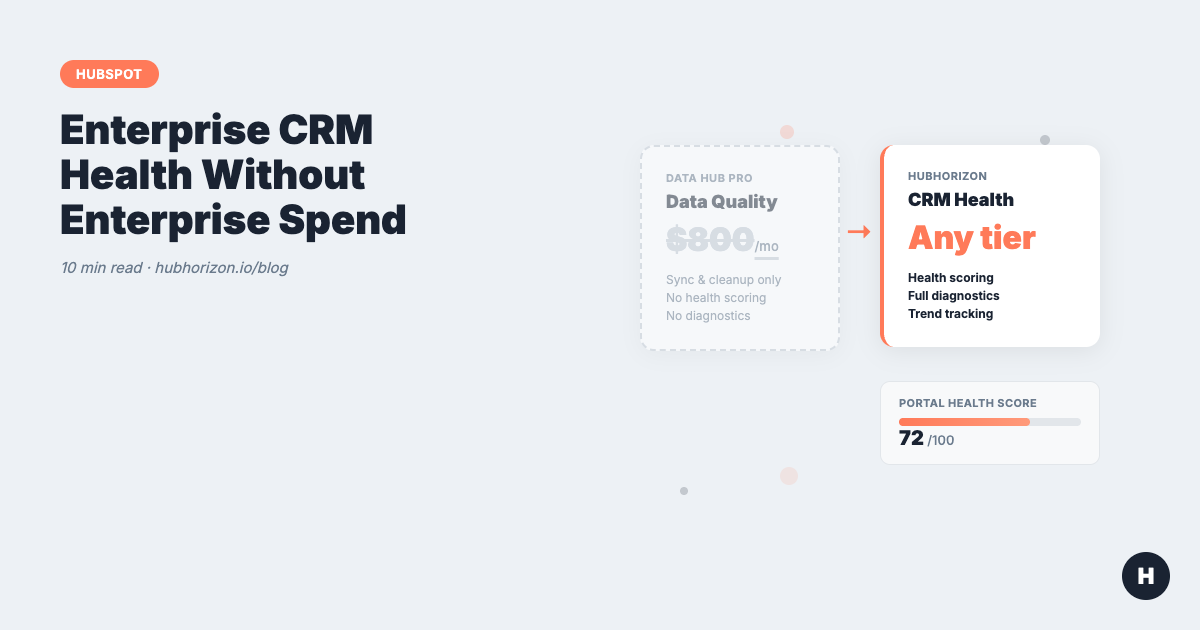
You don't need HubSpot's $800/month Data Hub to understand your CRM health. HubHorizon delivers health scoring, diagnostics, and actionable reports on any HubSpot tier.

Peter Sterkenburg
HubSpot Solutions Architect & Revenue Operations expert. 20+ years B2B SaaS experience. Founder of HubHorizon.
The CFO asked me one question last quarter: "Is our CRM data reliable enough to forecast Q3?"
I had no answer. Not because I didn't care about data quality. I'd spent two years trying to keep our HubSpot portal clean. But "reliable enough" isn't a feeling. It's a measurement. And our HubSpot plan didn't include the tools to measure it.
The Data Quality Command Center was behind HubSpot's $800/month Data Hub paywall. The property insights that might have helped us understand our data coverage were locked at Professional tier. I didn't need a data pipeline tool or a warehouse connector. I needed a health score, a single number that would let me tell the CFO whether our CRM data was getting better or worse, and what was dragging it down.
That's the gap HubHorizon fills. Not as a replacement for Data Hub, but as an answer to a different question.
The Data Hub pricing reality
HubSpot rebranded Operations Hub to Data Hub at INBOUND 2025. The rebrand came with new features, but the pricing structure tells you who it's really for.
Data Hub Starter: $20/month. You get data sync with custom property mapping across HubSpot's integration library. That's useful for keeping your tools connected, but there are zero data quality features at this tier. No Data Quality Command Center. No formatting automation. No enrichment. If you're buying Starter for data quality insights, you'll be disappointed.
Data Hub Professional: $800/month. This is where the quality tools start. The Data Quality Command Center, Data Studio, Smart Enrichment, programmable automation, warehouse integrations, and 5,000 credits for AI-powered features. At $9,600 per year for a single seat, this is a serious investment, and it's additive. You still need your Marketing Hub, Sales Hub, and/or Service Hub subscriptions on top of this.
Data Hub Enterprise: $2,000/month. Governance controls, unlimited connections, enterprise security, and 10,000 credits. At $24,000 per year, this is aimed at large organisations with complex data architectures.
Here's what most mid-market teams discover: the data quality features they actually need start at $800/month. The Starter tier is a sync tool, not a quality tool. And for teams already paying $800-3,600/month across their other HubSpot Hubs, adding another $800/month for data quality visibility is a hard conversation with finance, especially when you can't yet prove what your data quality problems are costing you.
It's a catch-22. You need data quality tools to demonstrate the problem. But you need to demonstrate the problem to justify the tools. The audit tools comparison covers this gap in detail.
What you actually need vs. what Data Hub sells
Most RevOps teams asking about data quality tools don't need data pipelines, warehouse connectors, or programmable automation. They need answers to simpler questions:
- How healthy is our CRM data, overall?
- Which objects are in the worst shape?
- What should we fix first?
- Are we getting better or worse?
- Can we produce a report that proves it?
Let's map those needs to what's available:
| "I need to..." | Data Hub | HubHorizon |
|---|---|---|
| Know my overall CRM health score | Not available at any tier | Free tier |
| Find unused properties | Pro ($800/mo), basic anomaly flags | Any tier, full audit with usage analysis |
| Audit association completeness | Not available at any tier | Any tier |
| Track health trends over time | Not available at any tier | Any tier |
| Get an AI readiness assessment | Not available at any tier | Any tier |
| Export an audit report for leadership | Not available at any tier | Pro tier |
| Compare health across multiple portals | Not available at any tier | Partner tier |
| Prioritise issues by business impact | Flags issues, no ranking | All tiers, ranked remediation plans |
| Sync data across tools | Starter ($20/mo) and above | Not available |
| Auto-fix formatting issues | Pro ($800/mo) | Not available |
| Auto-enrich missing data | Pro ($800/mo) | Not available |
| Connect to data warehouses | Pro ($800/mo) | Not available |
| Write custom workflow code | Pro ($800/mo) | Not available |
Look at where the columns fill in. Data Hub is a data operations platform: it moves, cleans, and enriches. HubHorizon is a data intelligence platform: it scores, diagnoses, and prioritises. The one you need depends on which problem you have.
If your pain is "data is flowing into HubSpot from six tools and the formats are inconsistent," Data Hub is your answer. If your pain is "I have no idea whether our CRM data is good enough to make decisions on," HubHorizon is your answer.
Most teams I talk to have the second problem. They don't need more data flowing in. They need to understand the data they already have.
What $800/month buys you (and what it doesn't)
Let's be specific about what Data Hub Professional includes, because the marketing page makes it sound all-encompassing:
What you get for $800/month:
- Data Quality Command Center that flags duplicates, formatting issues, and outdated records with AI assistance
- Data Studio for blending data from multiple sources in a spreadsheet-like interface
- Smart Enrichment that auto-fills missing record data from email conversations and third-party sources
- Bi-directional data sync with advanced field mappings across 1,600+ integrations
- Warehouse integrations with Snowflake, BigQuery, Redshift, and S3
- Programmable automation for custom workflow logic
- 5,000 credits per month for AI-powered features
What you don't get at any Data Hub price:
- A composite CRM health score or per-object quality scores
- Cross-object diagnostics: are contacts associated with companies? Are deals linked to the right pipeline stage? Is your data structure coherent?
- Full property audit: which of your 400 custom properties are actually in use? Which have data? Which follow naming conventions?
- AI readiness scoring: is your data structured well enough for Breeze AI to produce reliable outputs?
- Historical trend analysis: are things getting better or worse over the last six months?
- Exportable health reports for leadership or client meetings
- Multi-portal health comparison for agencies and Solutions Partners
- Prioritised remediation ranked by business impact, not just issue count
Data Hub wasn't designed to answer "is our CRM healthy?" HubSpot built it to keep data flowing and clean. That's a different job.
The real savings
The cost comparison isn't just Data Hub vs. HubHorizon. It's about what you're currently spending to answer the question "how's our data?"
Scenario 1: You're commissioning periodic audits.
A HubSpot portal audit from a Solutions Partner runs $3,000-8,000, depending on portal size and scope. The true cost of audits goes beyond the invoice: internal hours spent preparing, the two-week wait for results, and the stale-by-delivery-date problem. Most teams run these quarterly at best, which means three months of unmonitored data drift between each snapshot. At $3,000/quarter, you're spending $12,000/year for four point-in-time reports.
HubHorizon gives you continuous monitoring. Not four snapshots per year. Live scores that update every time you run an analysis. Property audits, association diagnostics, AI readiness assessments, and exportable reports, all available on demand.
Scenario 2: You're considering Data Hub Pro for data quality visibility.
Data Hub Professional costs $9,600/year. If your primary motivation is understanding data quality (not data sync or warehouse connections), you're paying $9,600/year for tools that flag issues but don't score, trend, or prioritise them.
HubHorizon delivers the diagnostic layer at a fraction of that annual spend. And it works on any HubSpot tier. You don't need to upgrade your CRM subscription to get CRM health insights.
Scenario 3: You're doing it manually.
The most expensive option, measured in time. Manually auditing a HubSpot portal with 200+ custom properties, 50,000+ contacts, and multiple pipelines takes 15-25 hours of focused work. And it tells you what's wrong today, not whether things were better or worse three months ago. Teams doing manual audits typically give up after the second one, because the effort-to-insight ratio is miserable. The ROI of proper data cleanup becomes clear only when you can measure it continuously, which manual audits can't do.
What HubHorizon gives you without Data Hub
Here's what's available right now, on any HubSpot tier.
Composite health scoring. A single number (0-100) for your overall CRM data health, broken down by object type. Contact quality, company quality, deal quality, each scored individually. The score accounts for data quality dimensions like completeness, accuracy, consistency, and timeliness.
Cross-object diagnostics. Association analysis across contacts, companies, deals, and tickets. Are your records connected? Are the relationships complete? HubHorizon checks association completeness and flags orphaned records, missing relationships, and structural problems that single-object cleanup tools can't see.
Property audit. Every custom property across all objects, analysed for usage. Which properties have data? Which are referenced in workflows, forms, and views? Which have never been populated? Which violate your naming conventions? The audit quantifies property sprawl and gives you a specific list of properties to archive, merge, or fix.
AI readiness assessment. A six-dimension analysis of whether your CRM data can actually support AI tools like HubSpot's Breeze. Not "do you have data?" but "is your data structured and consistent enough for AI to produce reliable outputs?" Includes specific recommendations for improving readiness across each dimension.
Trend tracking. Historical scores that show whether your data quality is improving or declining. This is the difference between "we cleaned up 200 duplicates" and "our CRM health improved from 54 to 71 over the last quarter." Trends make data quality work visible to leadership.
Prioritised recommendations. What to fix first, ranked by business impact. The difference between a 50-item issue list and a prioritised remediation plan is the difference between "this is overwhelming" and "start here."
When you DO need Data Hub (and HubHorizon together)
I'm not going to pretend HubHorizon replaces Data Hub. They do different things. Here's when Data Hub is worth the money:
You're syncing data across 10+ tools. If data flows into HubSpot from Salesforce, Stripe, Intercom, Zendesk, your proprietary app, and six others, Data Hub's sync infrastructure pays for itself. Managing 10+ integrations with ad-hoc Zapier connections breaks eventually. Data Hub's native sync with advanced field mappings handles this at scale.
You need warehouse connections. If your data team needs HubSpot data in Snowflake or BigQuery for analytics beyond what HubSpot's reporting can do, Data Hub's native warehouse integrations are cleaner than building custom ETL pipelines.
You need programmable automation. If HubSpot's standard workflow builder can't express the logic you need, Data Hub's programmable actions fill the gap.
You're investing heavily in Breeze AI. If you're paying for Breeze AI features and want to maximise their output quality, Data Hub's Smart Enrichment helps ensure Breeze has rich context to work with. But pair it with HubHorizon's AI readiness scoring to verify the enrichment is actually improving AI outputs, not just adding data volume.
Even in these scenarios, add HubHorizon. Data Hub tells you the data is clean. HubHorizon tells you the data is healthy. Clean data with broken associations, missing properties, and structural problems is still unhealthy data. HubHorizon's diagnostics help you prove that Data Hub's $800/month investment is delivering measurable results. That's an easier conversation with finance than "trust us, the data is cleaner."
Stop waiting for the budget you won't get
Here's the uncomfortable truth about the data governance gap in most organisations: teams know their CRM data has problems. They know they need better tooling. But the budget conversation for an $800/month Data Hub subscription gets deferred quarter after quarter, because nobody can quantify how bad the problem actually is.
That's backwards. You don't need expensive tooling to diagnose the problem. You need a diagnosis to justify the tooling. Start with HubHorizon. Get your health score. Understand where the gaps are. Produce a report for leadership that shows exactly what's wrong and what it's costing the business. Then, if the diagnosis points to data sync or enrichment needs, you have a data-driven case for Data Hub, not a gut feeling.
Most teams I work with discover that their biggest data quality problems aren't about sync or enrichment at all. They're about property hygiene, association completeness, and structural consistency, all things that HubHorizon diagnoses and that any team can fix without additional HubSpot spend.
Don't let the perfect data stack be the enemy of understanding what you've got. Portal health insights don't require Enterprise pricing. They never did.
Start your free portal health check at hubhorizon.io
Peter Sterkenburg is the founder of HubHorizon and has spent the last decade working with HubSpot portals across hundreds of organisations. He builds tools that help RevOps teams understand their CRM data without needing an Enterprise licence or a consulting retainer.
Related articles
HubSpot Data Hub + HubHorizon: The Complete Data Governance Stack
Data Hub handles sync, cleanup, and enrichment. HubHorizon handles health scoring, diagnostics, and prioritised action plans. Together they're the complete CRM data governance stack.
Read articleThe HubSpot Pipeline Management Cheat Sheet: Views, Signals, and Reviews in One Place
One-page HubSpot pipeline reference: 6 deal health signals, warning thresholds, 9 saved view recipes, stage design checklist, and review prep guide.
Read articleYour HubSpot Pipeline Is a Data Structure. Most Are Broken.
Your deal pipeline is a data structure. When stages, exit criteria, and required properties break, forecasting and AI produce garbage. Diagnose and fix it.
Read article